
Water Supplies of the Holy Land
Source: Picturesque Palestine, vol. 3, p. 81
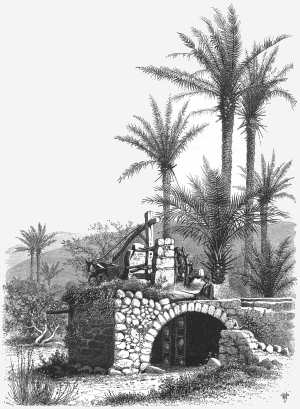
A Well in a Garden of Haifa
A pleasant sound of falling water attracted us towards a rudely built stone reservoir . . . . Water was falling with considerable force into the reservoir from a duct supplied by a series of earthenware jars attached to ropes made of palm fibre, which revolved round a vertical cog-wheel, moved by means of a horizontal wheel also cogged, which was kept in motion by a blindfolded mule. As the creaking wheel turned round, the jars dipped into the well and were filled with water, and as soon as they reached the top of the wheel they emptied themselves into the trough, and so on again and again as long as the mule kept up his monotonous round, urged on by a little barefooted boy, stick in hand . . . . (This machine is called a sâkiyeh; it is said to be of Persian origin and is much used in Egypt.) A hole in the lower part of the wall of the reservoir was every day unplugged for a certain time, and the water allowed to flow into the little furrows or channels which intersected the beds of vegetables and encircled the trees. (Source: Picturesque Palestine, vol. 3, pp. 94-95.)
En Gedi, Upper Spring
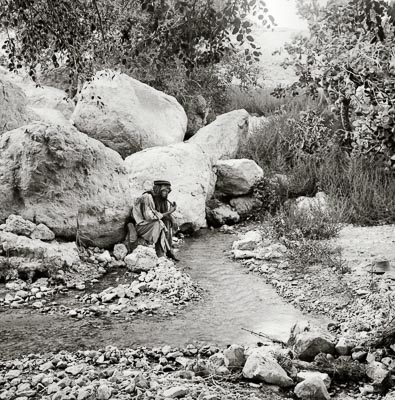
At the base of a rock, the copious warm fresh "Fountain of the Kid" (En-gedi or 'Ain-Jidy) bursts forth amidst an oasis of tropical vegetation . . . . The full stream gushes out from beneath a huge boulder upon a narrow terrace of rock four hundred feet above the level of the [Dead Sea], and, rushing down the steep declivity, its course hidden by rich tropical vegetation, flows out upon a broad patch of alluvial soil . . . . Over this it dashes in a sparkling cascade, and again collects itself below in a quiet pool fringed with graceful tamarisks and fragrant oleanders. The roots of the luxuriant growth, however, absorb the water, and the brook never finds its way down to the sea. The water of the spring is warm (83° Fahr.), of a sweetish taste, and impregnated with lime . . . . Farther to the north the fountains of 'Ain Terabeh, el Ghuweir ("the little lowland"), and El Fesh-kah, the last a large and copious one, flow into the lake, but their waters are brackish, and the spring of 'Ain Jidy seems to be the main source of sweet water on the western shore. (Source: Picturesque Palestine, vol. 3, pp. 191, 202, 203.)
Source: Earthly Footsteps of the Man of Galilee, p. 162
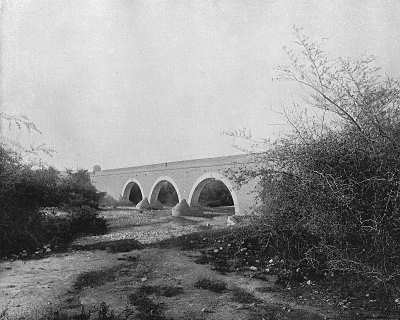
Aqueduct at Gilgal
Before reaching the modern village of Jericho, on the way to the Jordan, we see this beautiful acqueduct, one of the most handsome specimens of stonework that we found in Palestine. It is intended to convey the water from Elisha's Fountain into Jericho, and is a striking contrast to the miserable villages near it and the desolate plain around it. . . . Lieutenant Conder describes "no less than five acqueducts that follow the course of Wady Kelt, some of them irrigating the land south of it, while others carry the water north far and wide over the plain." The aqueduct suggests the original wealth and beauty of the land which was once watered by these springs at the foot of the Judean hills, therefore Jericho was in those days known as "the city of palm trees," but, save a single survivor, there are palms no longer. During the time of the Crusaders there were plantations of sugar cane here that brought large revenue to the Knights of Jerusalem, and the ruins of the vaults and acqueducts that supplied water for irrigation are still seen. (Source: Earthly Footsteps of the Man of Galilee, p. 162.)
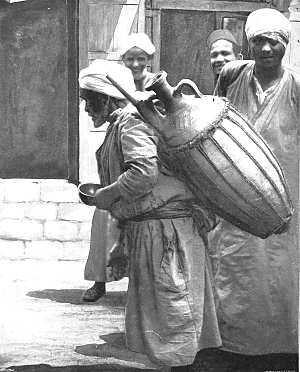
Water Carriers
Source: Earthly Footsteps of the Man of Galilee, p. 77
"Ya Auwad Allah" (May God recompense me) is the cry of the Sakka or water carrier as he plies his trade in the streets of Cairo . . . . During eight months of the year he brings his heavy load all the way from the Nile, and the labor, which is severe, is miserably under-paid. During the remaining four months, while the river is rising, he obtains his supply from the canal which intersects Cairo. Many of the Sakkas sell water to the people on the streets. These are known as "Sakka Sharbeh." Sometimes they carry the water in a large earthen vessel on their backs, at other times it is carried in the ordinary goatskin bag. The thirsty passer-by receives his draught in a brazen chalice or in a Kulleh (porous bottle), and if he be generously inclined he bestows a small copper coin on the dispenser; otherwise the Sakka must find his satisfaction in the consciousness of a good deed done. (Source: Earthly Footsteps of the Man of Galilee, p. 77.)
See Marketplace, Water in Egypt, Water Systems in Jerusalem, or Women and Work
At BiblePlaces, see Warren's Shaft, The Pool of Siloam, or Hezekiah's Tunnel