
Baalbek, Temple Courts
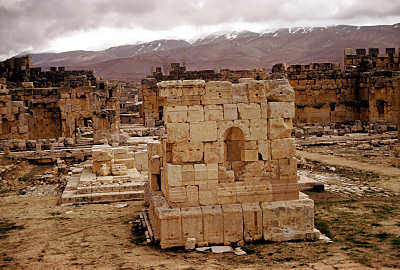
Baalbek Ruins with Snow Covered Mountains
Moving eastward, we now leave the six columns [of the Temple of Jupiter] . . . and enter the vast quadrangular area known as the Great Court, our course being that of the ancient devotees on passing out of the great temple. In front we see in the distance the triple gateway with the hexagonal court, and in a direct line another triple portal leading to the great portico. We pause in the great quadrangle. Here, around the sides, are gems of ancient sculpture enough to detain the artist for weeks. This court is four hundred and fifty feet from north to south, and about four hundred from east to west . . . . There are eight chambers with doors, eight rectangular alcoves with columns, four semicircular dome-roofed exedra, two niches eighteen feet wide for colossal statues, one on each side of the triple gateway leading into the hexagon . . . . The forty-four columns which supported the roofs of these alcoves were of Syenite granite, twenty-nine inches in diameter. As Wood found only the shafts of Syenite, he inferred that the bases and capitals of these columns were of the native limestone, the same rock with the rest of the temple-a very probable supposition. (Source: Picturesque Palestine, vol. 2, pp. 224-25.)
Baalbek Ruins
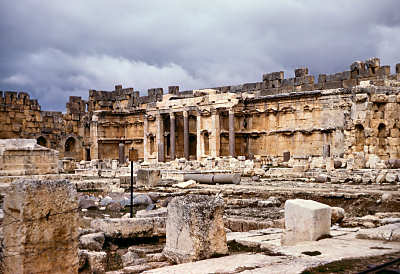
Turning north, we pass along about one hundred feet without finding traces of exedræ. In the north-west corner there is first a large chamber with a door, then a rectangular recess with four columns in front, a part of whose cornice is still unfinished, then a semicircular exedræ, with a magnificent groined roof supported by two columns. These alcoves, as well as the successive semicircular and rectangular exedra on the north, east, and south sides, are lavishly decorated with shell-topped niches, canopies, rosettes, and arabesques of the most elaborate and minute character. Here were statues innumerable, which doubtless now lie buried under the masses of débris which fill the area. The entablature ran uninterrupted all around the court, the frieze having rich ornaments of pomegranates, grapes, vine-leaves, and flowers. In one is a head surrounded with a fan-like canopy of scaly wings; in another a winged dragon. All are decorated within and without with pilasters. (Source: Picturesque Palestine, vol. 2, p. 225.)
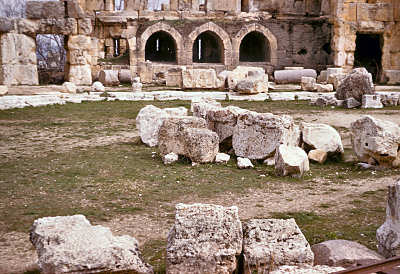
Baalbek Ruins
On the east of the quadrangle is a triple gateway, the broad portal now in ruins, being fifty feet wide, with two side portals of ten feet, leading into the hexagonal court. This hexagon is two hundred feet in breadth, east and west, and two hundred and fifty from north to south. On the east and around the north and south angles were rectangular exedra or alcoves, with smaller rooms intervening. The roofs of the alcoves were supported by twenty columns, all now fallen. The effect of this hexagonal court to one entering from the eastern portico must have been impressive, with its fine proportions and the glimpses of the great peristyle beyond. (Source: Picturesque Palestine, vol. 2, p. 225.)
South Side of the Great Court, Baalbek
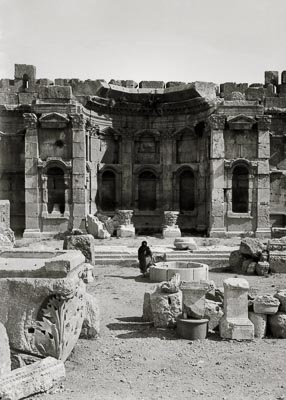
Descending into the interior of the temple, we see that it had no windows, and probably it was only partially roofed. The nave measures about ninety feet in length by seventy-four feet in width. On the sides up to the sanctum it had eight fluted half columns, with Corinthian capitals, and having two niches between them, one above the other. The lower niches were arched and elaborately sculptured; the upped had highly ornamented triangular pediments, supported by slender columns, and they appear to have had central pedestals for statues. The semi-columns in the corners on either side of the portal were double, and the sanctum at the west end had square pilasters on the sides, with Corinthian capitals. (Source: Thomson 1885: 332.)
See Baalbek, Temple Courts, Temple of Jupiter, Palmyra, or Damascus
At BiblePlaces, see Baalbek
Source:
Thomson, William M.
1885 The Land and the Book. Vol. 3: Lebanon, Damascus, and Beyond Jordan. New York: Harper & Brothers.