
Baalbek, Temple of Jupiter
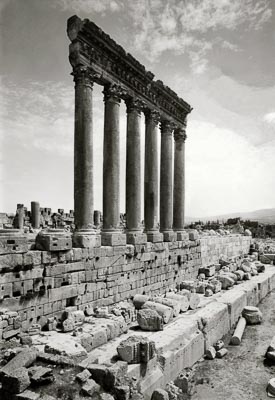
The Six Columns of the Great Temple, Ba'albek
But the crowning feature in the ruins of Ba'albek is the six columns. The first rays of sunrise fall upon the aerial entablature, seemingly hung in mid air, and the last rays of sunset gild it with indescribable glory. The first thought is one of wonder that they have stood so long. They stand on a wall fifty feet in height, which formed the southern wall of the great temple or peristyle . . . . This temple fronted toward the east on the great quadrangular court. Its western wall stood on the three great stones, and its northern on a splendid wall of drafted masonry of thirteen courses, about forty-eight feet in height. The great peristyle was two hundred and ninety feet in length by one hundred and sixty in breadth. On each side were nineteen Corinthian columns like the six now standing, and at each end ten-fifty-four in all. The pedestals of the most of these columns are still in situ. (Source: Picturesque Palestine, vol. 2, pp. 221-22.)
Baalbek, Jupiter Temple
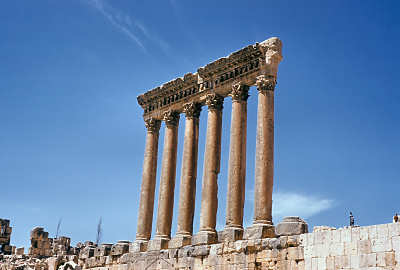
The diameter of the columns is seven feet and three inches at the base, and six feet six at the top. As you look at them from a distance they seem much smaller, the perfect grace and symmetry of the proportions completely deceiving the observer; and it is only when standing by the base of a prostrate column and actually measuring it, that one can credit its immense size, and believe that it is more than twenty-one feet in circumference. Each shaft is composed of three stones, and the height from the base to the top of the capital is seventy feet. Add to this fifteen feet, the height of the entablature, ascertained by measuring the fragments on the ground, and the wall of forty feet below, and we have a total height of one hundred and twenty-five feet above the plain. What adds greatly to the beauty of the six columns now standing is the orange-coloured weather rust, which gives them a golden glow in almost every light, whether morning, noon, or sunset, and a mellow tint even by moonlight. (Source: Picturesque Palestine, vol. 2, pp. 222-24.)
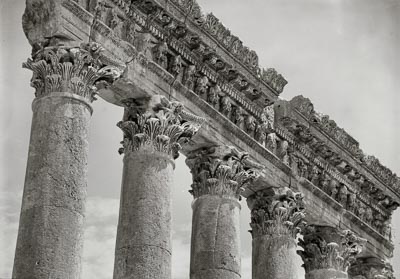
Baalbek, Jupiter Temple Entablature
The three stones of which each is composed were jointed with mathematical precision, so that at a short distance, even after the attrition of centuries, the joints are almost invisible. The carving of the capitals on the northern face is almost completely gone, while on the south side it is perfect. The reason is, the bitter freezing winds which blow from the north during the winter months are gradually disintegrating the stone. You are never weary of looking at the columns. At any distance, from any side, and in any light, they are the same majestic awe-inspiring objects, and you envy the artist traveller who can transfer to canvas their inimitable proportions and exquisite colouring. In the time of Wood and Dawkins, in 1751, nine of these columns were standing . . . . An eave trough ran along the whole length of the cornice on the top, and over every column was an eave spout of stone, some of which in both temples are still perfect. Whether roofed or open, whether vaulted or hypæthral, it must have been the glory of its age, and the finest specimen of Corinthian architecture ever built. (Source: Picturesque Palestine, vol. 2, p. 224.)
See Bacchus Temple, Temple Courts, Palmyra, or Damascus
At BiblePlaces, see Baalbek