
Bedouin
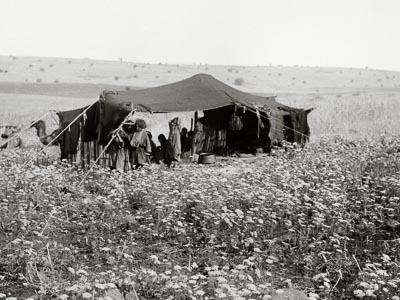
Bedouin Tent in Capernaum
Now we come up to a very small Arab encampment . . . . There are one or two dark blackish-brown striped tents of goat's-hair, with a small whitish pattern woven in at the edge, propped up on sticks; though not large, they are divided in order to separate women and men. So low is the tent and scanty is its accommodation, that a good-sized tent is rolled up round its proper sticks into a bundle not much bigger than those awful bundles of sticks and rugs which are thrust into first-class carriages at Charing Cross Station, to the annoyance of small travellers. There was not much life in the encampment, and not much to observe. (Source: Picturesque Palestine, vol. 4, p. 10-11.)
Bedouins Drawing Water
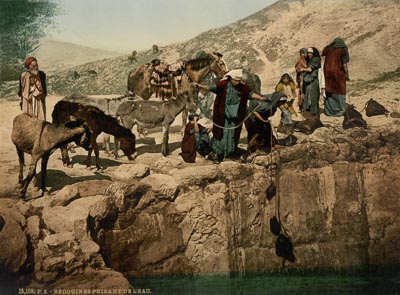
Source: The Holy Land in Photochrom
The Bedouins are professedly Moslems, and are the direct descendants of the half savage nomads who have inhabited Arabia from time immemorial. They live by cattle breeding, and possess immense herds of sheep and camels . . . . The Bedouins are wandering tribes and are objects of peculiar interest to the travelers. "Their object in living seems to be to rob other tribes and to fight injured parties afterwards." They are, nevertheless, polite and hospitable. However crowded the premises, the guest, be he friend, stranger or even foe, has the best place in the tent and the choicest portion of food, and the host would protect him at the risk of his life against insult or attack were the assailant of his own tribe and kindred. (Source: Earthly Footsteps of the Man of Galilee, pp. 106, 154.)
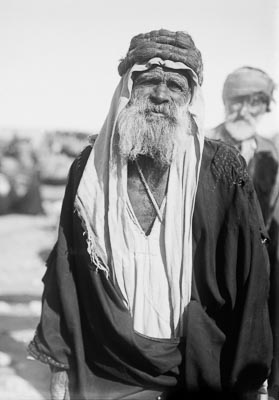
Elderly Bedouin Man from Beersheba
I have said nothing about the dress of the Bedawín of Sinai . . . . Well, these dignified Towarah are dressed in very poor rags. There is a white coarse surplice, or shirt, coming down a little below the knees, with very long pointed sleeves; this is fastened round the waist with a broad strong leathern belt; in the bosom of this shirt, or knotted up in the ends of the sleeves, the Arab carries any odds and ends of wealth he may possess. Most of them have a pair of sandals (the best are made of fish skin), though they don't always use them, perhaps hardly ever in the open desert. Generally they wear the turban and fez instead of the picturesque kefíyeh. The 'abba, a great straight garment about two and a half or three yards wide, with holes for the arms to come through, and usually with a capote or hood attached, is stowed away on the camel, but always ready to hand for storm or cold. (Source: Picturesque Palestine, vol. 4, pp. 7-8.)
Bedouins Buying Spears
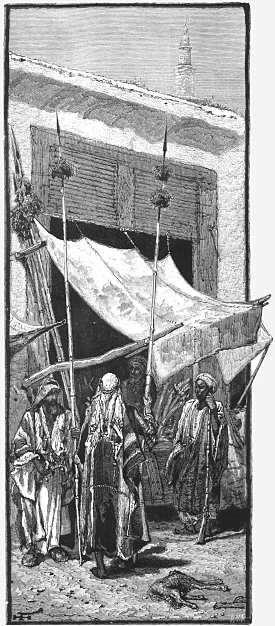
Source: Picturesque Palestine, vol. 2, p. 180.
For arms the Arab has a sword (those I looked at were European blades), which answers, like the kookree of the Ghoorkas, for many purposes, and a long gun. Some also carry spears. But the armoury depends on the purse; and several of our Arabs had no weapons whatever, while amongst the Towarah, who are in many ways, owing to their isolated position in a peninsula, to be distinguished from other Bedawín, one does not notice many spears. (Source: Picturesque Palestine, vol. 4, p. 8.)
See Arabs, Muslim Customs, Muslim Religious Practices, Abraham's Sojourn, Psalm 23, or Shepherds and Flocks
At BiblePlaces, see Sheep and Shepherds