
Beirut Coast
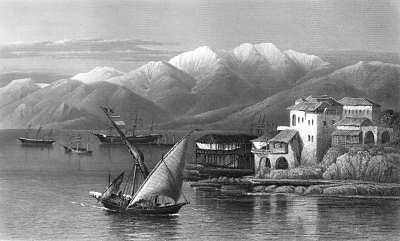
Source: Picturesque Palestine, vol. 3, facing p. 36
Bay of Beirut
If St. Paul went by sea [from Caesarea] all the way to the port of Tarsus, he passed perhaps near or in sight of Beyrout, and if he went all the way by land he doubtless, in following the coast road, would pass through Beyrout. At that time, A. D. 39, Beyrout must have been a town of some note. It is now the most important commercial town in Syria and the situation is exceedingly beautiful. The rosy tint of the mountains contrasting with the deep blue of the sea presents a most picturesque scene by evening light . . . . Upon landing from the sea at Beyrout the traveler enters upon a bustling scene and a Babel of tongues falls upon his ear. Numbers of boats with fantastically dressed occupants dance upon the waves round our vessel; scores of porters shout their deep gutturals into the ears of impotent travelers as if an excess of sound would render their tongue intelligible. (Source: Earthly Footsteps of the Man of Galilee, p. 311.)
Beirut, Sea Front
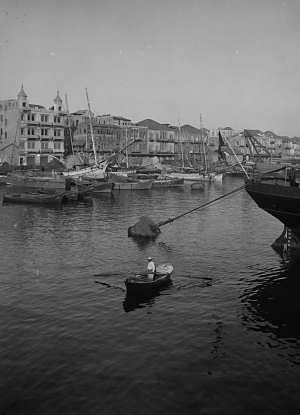
The European appearance which Beyrout presents and its prosperity are entirely owing to the foreign influence. The principal article of export is raw silk, and Lebanon is in fact becoming one vast mulberry plantation. Fishing has become one of its chief industries, and its bay is just such a harbor as fishermen appreciate and delight in. The fisheries are extensive and profitable. The Syrian Protestant College, established many years ago by the Presbyterians, has been one of the most important factors in the prosperity of this Syrian city. Cultivated and earnest men have devoted themselves with marvelous diligence, ability and fidelity to the work of educating the young Syrians, especially from the mountains of Lebanon, who have come to them. Teachers, ministers, business men, are now scattered all through Syria and Asia Minor, the products of this admirable institution of learning. (Source: Earthly Footsteps of the Man of Galilee, p. 312.)
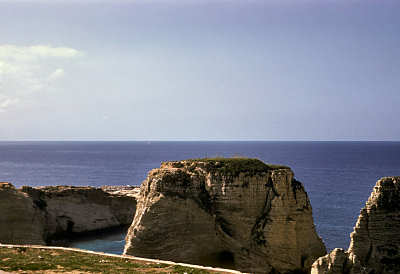
Beirut Pigeon Rocks, Suicide Point
About one mile south-west of the College, the cape of Râs Beirût terminates in an abrupt cliff at the Rausheh, the old Syriac name for râs, or headland. The cliff is worn away in a curve, at the base of which is a deep grotto or cavern only to be approached by rowing boats. Opposite the mouth of the cavern, and in the focus of the semicircle formed by the cliff, rise the two picturesque Pigeon Islands, under one of which is a natural tunnel. Not only pigeons, but vast shoals of seals formerly added interest to the spot. The cretaceous rock presents a curious appearance with its alternate strata of white chalk and black flint, and the distortions and curvatures of the strata are beautifully marked in the islands. On a recent visit during a westerly gale the scene was one of indescribable grandeur. The mighty waves came rolling in from the deep sea, and, striking upon the ledges outside the islands, burst into milky foam and swept around and behind the islands with deafening roar, dashing far up the cliffs and falling back into the boiling abyss of waters . . . (Source: Picturesque Palestine, vol. 3, pp. 38-39.)
The Bay of St. George
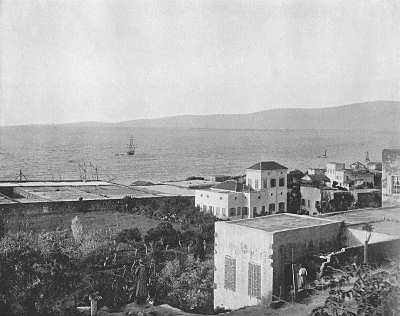
Source: Earthly Footsteps of the Man of Galilee, p. 316
We have in the above picture our last view of the bay of St. George, around which stands the ancient and lovely city of Beyrout. We see gardens, houses, the peaceful bay, the shipping and the coast range of Lebanon. This bay is called after St. George, concerning whom there are legends and legends. The old story of St. George and the dragon is familiar to all. Tradition says that near this the dragon was killed, and that afterwards St. George washed his hands in the waters of the bay. There is a poetic charm in these bays that let themselves into the shore, making the wider sea accessible, and receiving the contributions of streams from the valleys and the mountains. (Source: Earthly Footsteps of the Man of Galilee, p. 316.)