
Cafés and Coffee
Source: Picturesque Palestine, vol. 1, p. 33
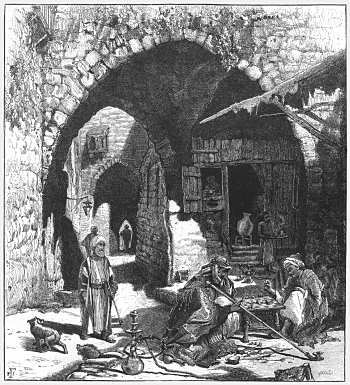
A Street Café, Jerusalem
From David Street a turning towards the north, called Christian Street, leads to the Church of the Holy Sepulchre, and here there are a few European shops, kept by Maltese, Italians, and Germans, in the midst of the truly Oriental barbers, pipe-makers, bakers’ shops, and cafes. A good example of one of the less important street cafes is shown [in the illustration]. All that is absolutely necessary is a nook in which a fire can be made for the preparation of pipes and coffee, a supply of coffee cups, narghilehs, and long pipes, and a few rush seats; but the proprietor adds greatly to the attractions of his establishment if he can supply a board for the game called dameh, at which a Bedouin and a peasant are represented playing in the illustration. In the evening a story-teller or a singer may generally be found here entertaining a group of smokers. (Source: Picturesque Palestine, vol. 1, p. 36.)
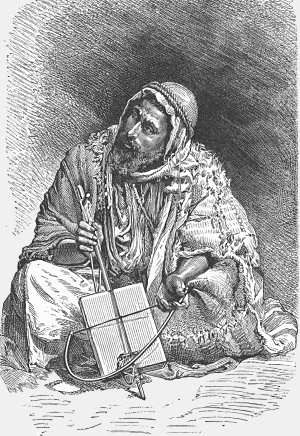
Musician in Café
Source: Jerusalem, Bethany, and Bethlehem, p. 71
Another phase of Jerusalem life one occasionally meets with. I have encountered it more frequently, however, in Damascus and Cairo. Passing along the street, the sound of music—or at least what Orientals call music—is heard from an open café. Entering, we see a man, generally in the costume of a desert Arab, with flowing kerchief over his head, bound by a double fillet of camel’s hair, squatting on the ground, and playing with a rude bow on an instrument which, in simplicity of design and rudeness of workmanship, might be the counterpart of that which David played before Saul. The notes are somewhat metallic, but not altogether unpleasant, and they are generally accompanied by a slow nasal chant one might mistake for a funeral dirge. Yet the natives of all classes enjoy it, and listen with rapt attention, as if it were the perfection of harmony and the master-piece of a musical genius. (Source: Jerusalem, Bethany, and Bethlehem, p. 71.)
Source: Earthly Footsteps of the Man of Galilee, p. 291
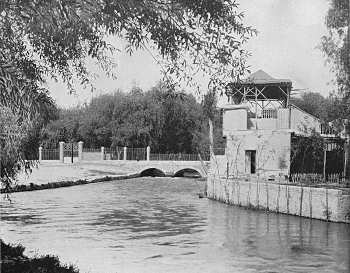
Coffee Garden, Abana River
Coffee is the national drink of the Moslems as beer is of the Germans, wine of the French and pulque of the Mexicans. Let us visit an oriental coffee garden. This view is within the walls of Damascus. Here groups of natives will always be found in the afternoon sipping from small cups of black coffee and smoking either cigarettes or nargileh pipes. The city is filled with coffee gardens, which are shaded by beautiful trees and adorned by flowering shrubs. Large rose-bushes grow in all of them, and from these gardens the roses are taken which make the famous attar of roses. In daylight these gardens have a half wretched look, but at night they are like scenes of the Arabian Nights. One writer says: "A hundred miniature lamps of every form and color glimmer among the branches of trees above fountains and long balustrades reflected in the river below. Turbaned heads and venerable beards loom dimly through clouds of smoke; and here probably on some elevated branch a story-teller is perched reciting, as an oriental only can recite, one of the tales of Antar, or some legend equally ancient, to a crowd of eager listeners." (Source: Earthly Footsteps of the Man of Galilee, p. 291.)
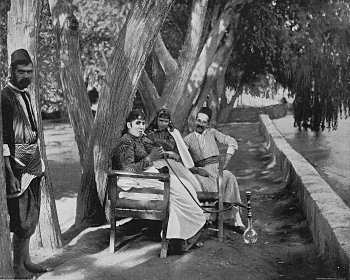
Coffee Garden, Damascus
Source: Earthly Footsteps of the Man of Galilee, p. 296
This is a scene taken by our artist in another of the numerous coffee gardens of Damascus . . . . We have here a specimen of the nargileh, of which we speak so often. Through its amber mouthpiece the smoke passes into the mouth from a cup on the top, where the tobacco is lighted by a coal of fire, through the perfumed water in the bulb below, and is very palatable . . . . Refreshments in Damascus are not confined to cafes and gardens, numerous as these places are in the city. In these places one hears oriental music-- curious instruments, bursts of song, a violin, flutes, tambourine, kettle-drum, a harp, and sometimes castinets are added. But these people know nothing of harmony . . . . One would suppose from the number of cafes that the people do little else than smoke and drink. In truth, a large part of their time is spent in this way. Every house or shop is a sort of drinking place. Upon entering a carpet or silk shop one of the first questions the proprietor asks the customer is if he will have coffee. Until coffee is brought and served no attempt is made to strike a bargain. (Source: Earthly Footsteps of the Man of Galilee, pp. 296-97.)
See Marketplace, Houses, Women and Clothing, or Women and Work