
Cairo
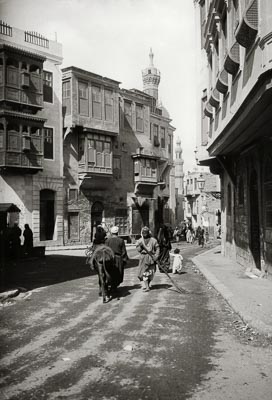
Source: American Colony: Egypt and Sinai
Street in Cairo
Cairo is still the ideal city of the Arabian Nights. We can still shut our eyes to the hotels and restaurants, the dusty grass-plots, and tawdry villa residences of the modern bricklayer's paradise, and turn away to wander in the labyrinth of narrow lanes which intersect the old parts of the city, just as they did in the days of the Memlûk sultans. And as we thread the winding alleys, where a thin streak of sky marks the narrow space between the lattice-windows of the overhanging upper stories, and dive under a camel here, or retreat into a recess there, to escape what seems imminent death at the feet of the advancing and apparently impassable crowd of beasts of burden, camels, asses, and horses, laden or ridden, we may fancy ourselves in the gateway of 'Aly of Cairo . . . . A few streets away from the European quarter it is easy to dream that we are acting a part in the veracious history of the Thousand and One Nights-which do, in fact, describe Cairo and its people and life as they were in the fifteenth century, and as, to a great degree, they are still. (Source: Picturesque Palestine, vol. 4, p. 136.)
Valley of the Nile and Pyramids
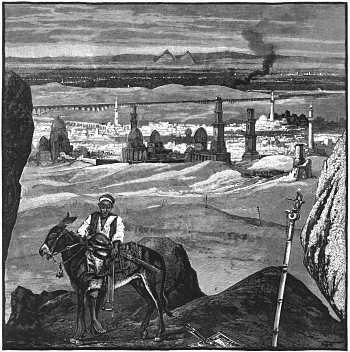
Source: Picturesque Palestine, vol. 4, p. 149
The Citadel is not worth seeing for itself so much as for the view . . . which spreads before the eye as one stands at sunset on its battlemented wall. Below lies the city with its countless domes and minarets-Sultan Hasan in the foreground-its wilderness of irregular tumble-down yellow and white flat-roofed houses, interspersed with many a garden and the dark foliage of the sycamores; beyond, a fringe of palms and a streak of silver show where the broad Nile rolls sleepily on between its brown banks. To the right, the huge dome and handsome minarets of El-Muayyad stand out prominently from among their fellows; beyond these the minarets of the Nahhâsîn; and at the end the two queer-shaped mebkharehs of El-Hâkim. To the left is the enormous court of Ibn-Tûlûn's mosque, and its strange minaret then the billowy mounds of Fustât; and in the distance, against the ridge that terminates the Libyan desert, in the carmine glory of the setting sun, stand the everlasting Pyramids, "like the boundary-marks of the mighty waste, the Egyptian land of shades." (Source: Picturesque Palestine, vol. 4, p. 158.)
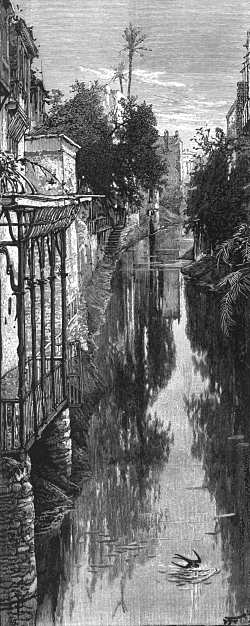
Source: Picturesque Palestine, vol. 4, p. 156
On the Canal (El Khalig)
This is El-Khalîg, or "the Canal" par excellence . . . which divides Cairo longitudinally from north-east to south-west into two strongly contrasted portions. West of the canal and next the Nile, the de-forming touch of the khedivial bricklayer has ruined everything. East of the canal the old Muslim city of the Fâtimis still retains its picturesque character . . . . Of the canal itself, it maybe remarked en passant that, though it is a favourite subject for Cairene poets, and the inhabitants love to smoke their pipes and enjoy their "keyf" or siesta in the houses and terraces overlooking it, and drowsily listen to the murmur of the water-wheel . . . it is only pretty during four months when the Nile fills it, while for the rest of the year "bright Khaleega" is a gutter of mud and a home for noisome smells. The people, however, are so fond of this unwholesome drain that no ruler dares risk his popularity by converting it into a street, though that is, undoubtedly, its proper destiny. (Source: Picturesque Palestine, vol. 4, p. 161-162.)
Cairo from the Citadel
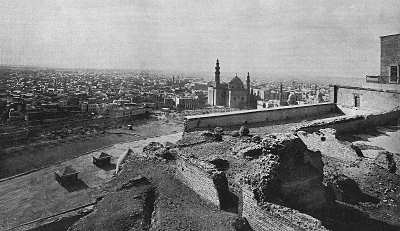
Source: Earthly Footsteps of the Man of Galilee, p. 43
From the citadel a fine view is to be enjoyed. Just below are the arsenal, the Rumeleh--a beautiful public square, the fine mosque of Sultan Hassan, the numerous minarets of Cairo, the ancient wind mills, the distant pyramids, and the green plain through which the Nile winds toward the sea. Miss Martineau says: "I would entreat any stranger to see this view, especially in the evening before sunset, when the beauty of it is beyond description. The vastness of the city as it lies stretched below surprises every one. It looks a perfect wilderness of flat roofs, cupolas and minarets, with an open space here and there, presenting the complete front of a mosque, gay groups of people and moving camels--a relief to the eye, though so diminished by distance." It is rarely a traveler enjoys a prospect so varied and charming. (Source: Earthly Footsteps of the Man of Galilee, p. 43.)
See Citadel of Cairo, Festival of Mah'mal, Giza Pyramids and Sphinx, or Memphis
At BiblePlaces, see Giza Pyramids