
Damascus Gate
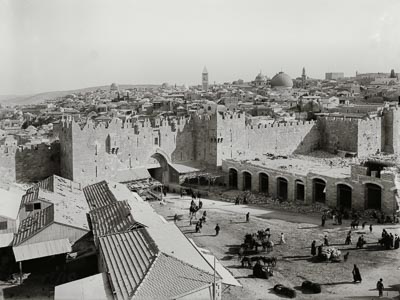
Source: American Colony: Jerusalem
Damascus Gate and the Old City
From the Bazaars, which lie immediately east of the old Hospice of the Knights of St. John, a street runs directly to the Bab el Amud (Gate of the Column), commonly known as the Damascus Gate . . . . This, the most picturesque of the city gateways, through which passes the great road to Nablus and Damascus, is the work of Sultan Suleiman, and dates from the sixteenth century. The gateway which preceded it was known in the twelfth century as that of St. Stephen, from the Church of St. Stephen, which then stood a few yards distant without the walls, on the place where the first Christian martyr is supposed to have been stoned. The scene of St. Stephen's martyrdom is now shown on the east side of the city without the present St. Stephen's Gate. The Damascus Gate is built over an older gateway, possibly as old as the time of Hadrian, which can just be seen rising above the rubbish. Flanking the gate are two towers built with stones taken from the ancient walls, and perhaps resting on the foundations of the older walls of the city. (Source: Picturesque Palestine, vol. 1, p. 31.)
Damascus Gate with Hadrian's Arch
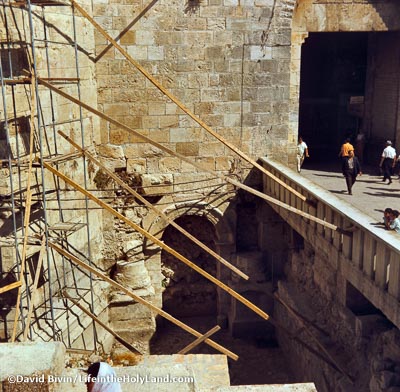
Excavations in the 1930s and 1960s revealed an earlier gate below the present Damascus Gate. This arch was a small side arch of the monumental gateway erected by the Roman Emperor Hadrian in A.D. 135. An inscription on the arch includes the name of the city given to Jerusalem by Hadrian, Aelia Capitolina. The scaffolding in the photo likely remains from the excavations conducted by J. B. Hennessy under Kathleen Kenyon, from 1964 to 1966.
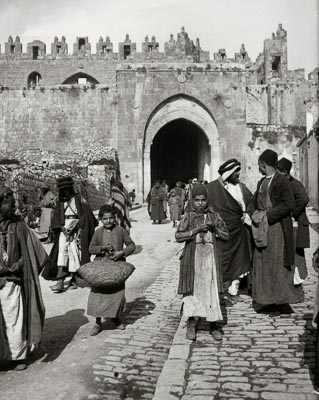
Source: American Colony: Jerusalem
Damascus Gate from Inside the City
The Damascus gate (the Bab El Amud) is by far the handsomest and most striking of the five entrances into Jerusalem. At either side, on the inside of the gate, are very slender columns, above which is a pointed pediment bearing an inscription. The Damascus Gate, with its, towers, battlements, turrets, and projecting parapets on either side, and above "the chamber over the gate," presents an appearance both beautiful and imposing. According to the inscription, it was built, or at least restored, by Soliman in the year 944 of the Hegira (beginning June 10, 1537), and is a fine example of the architecture of the sixteenth century. The tower of the gate commands a magnificent view. (Source: Earthly Footsteps of the Man of Galilee, p. 118.)
Damascus Gate, 1961
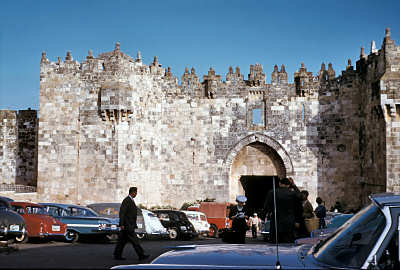
On both sides of the entrance are some fine specimens of ancient work. The stones employed are evidently the fragments of ancient structures, which have attracted the attention and discussion of students of Jerusalem topography. Captain Warren commenced excavations on both sides of the gate, but was not allowed by the authorities to complete them. He says: "This gate is at present built of two very different styles of masonry, the older portion of which is probably of the same age as the portions of the sanctuary wall." The results of Warren's explorations are important since they confirm the opinion that there was at that point a city wall and gateway at least as ancient as the time of Herod the Great. Under the gates there still exist subterranean chambers. The rushing of a subterranean water course is said to have been frequently heard below the Damascus gate. (Source: Earthly Footsteps of the Man of Galilee, p. 118.)
See Golden Gate, Jaffa, Old City Gates, or Mount of Olives
At BiblePlaces, see Gates of the Old City