
The Rivers of Damascus
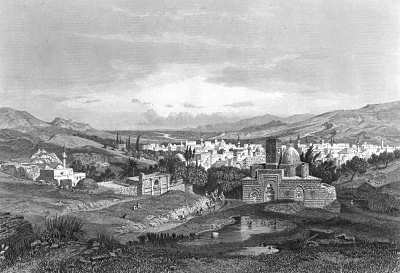
Source: Picturesque Palestine, vol. 2, facing p. 145
Rivers of Damascus
The beauty and fertility of the surroundings of Damascus are chiefly due to the abundance of water, this greatest of blessings in a sandy and rocky desert, and fit symbol of life and regeneration. Naaman of old very naturally thought the rivers of Damascus, Abana (or Amana) and Pharpar, far better than all the waters of Israel (2 Kings v. 12). They are now called the Barada (the Chrysorrhoas, or Gold River of the Greeks), and El ’Awaj . . . . They rush down from the Anti-Lebanon, call forth a luxuriant vegetation along their course, distribute their blessings in innumerable channels to the houses and gardens, and then lose themselves in the marshy Lakes of the Meadow, some eighteen miles east of the city . . . . This beautiful district shows what a Syrian desert may become under proper cultivation. No cultivation would, however, be attempted unless an ample supply of water could be provided for irrigation. That which is brought down by the different mountain streams is carried in many directions by a multitude of aqueducts, and distributed far and near. (Source: Picturesque Palestine, vol. 2, pp. 144-46.)
Abana River Passing the Gardens
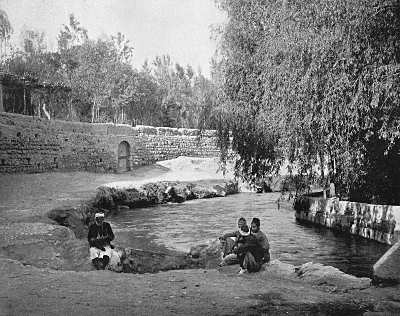
Source: Earthly Footsteps of the Man of Galilee, p. 274
The Abana River, which is now known as the Barada, rises among the Lebanons. The main source is Fijeh, about a day's ride to the southwest of Damascus. It enters the plain of Damascus through a deep ravine about one mile to the west of the outskirts of the city itself. The Pharpar River, which was called "one of the rivers of Damascus," does not enter the city at all. The life in the gardens, the beauty of the trees, the charm of the flowers, the green grass, the rich fruits, which distinguish the city of Damascus, it owes to the waters of Abana. This river is divided into numberless channels and is distributed throughout Damascus and the region immediately about it. In almost every house there is a fountain, and one can stand still almost anywhere and listen to the murmur of the hidden streams that pass under and through the city. (Source: Earthly Footsteps of the Man of Galilee, p. 274.)
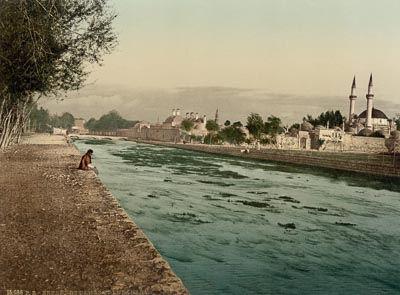
Source: The Holy Land in Photochrom
Stream of Barada
Damascus was once the capital of the world from the Atlantic to the Bay of Bengal, but the vast empire went from her, and the city continued to flourish as before. It has ever been a city utterly incapable of defense. Nineveh, Babylon and Memphis entirely conquered her; she probably preceded them and she has outlived them. She has been twice supplanted by Antioch, and she has seen Antioch decay; by Bagdad, and Bagdad is forgotten . . . . As Dr. Smith has eloquently said: "Because [the Abana] river, instead of wasting her waters saves them, and instead of slowly expanding them on the doubtful possibilities of a province lavishes all her life at once on a creation of a single great city and straightway disappears on the face of the desert— it is because of this that Damascus, so remote, and so defenseless, has endured through human history, and must endure." Thus is the river from the mountains a river of life to the city. The granite of the hills cannot comedown to make walls about the place, but the hills send down their waters and the city remains. (Source: Earthly Footsteps of the Man of Galilee, p. 280.)
Falls of the Abana, Damascus
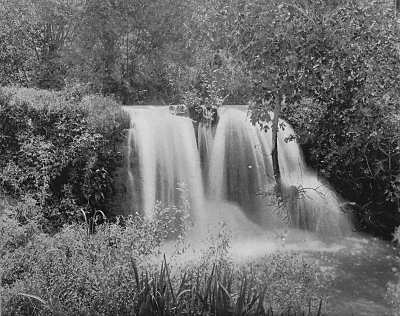
Source: Earthly Footsteps of the Man of Galilee, p. 283
On the 16th of May, 1894, early in the morning, the artist and one of the editors left Damascus by carriage, passed along the Beyrout road by the Abana River and reached a point about two miles from the city, where the above view was taken . . . . As Egypt is the gift of the Nile, so is Damascus the gift of the Abana. The chasm through which the river issues from the Anti-Lebanon is quite narrow. The lofty limestone cliffs on either side are jagged and precipitous. The foaming river, the waving trees, the tall poplars, the exuberant vegetation, present a view unique as it is picturesque. The stream rushes rapidly through its stony channel, and, leaping over the rocks, is torn into a snow-white sheet of water and is at once hidden among luxuriant growths of shrubs and bushes. On it rushes to the broad plain just below, and there begins that network of water-courses for which Damascus is celebrated. The desert lies like a fortification around Damascus. The river is its life. (Source: Earthly Footsteps of the Man of Galilee, p. 283.)
See Damascus, Damascus Great Mosque, Paul in Damascus, Baalbek or Palmyra
At BiblePlaces, see Acts 9