
Dead Sea
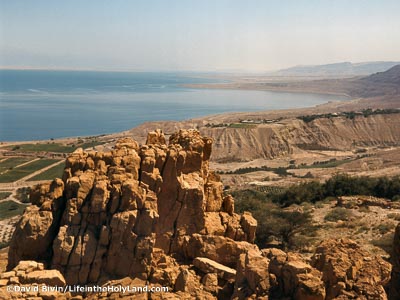
Southern End of the Dead Sea from En Gedi
Passing thence over a broad plateau, a favourite camping-ground of the Bedawîn, we reach at length the top of the Pass of Engedi, where the Dead Sea and the rugged mountains of Moab first burst upon the view . . . .When, as often happens in the rainy season, the sky is overcast with clouds, a dense haze obscuring the mountains, and a fleecy mist hovers over the water, the Dead Sea seems, indeed, worthy of its name: look where one may, no sign of life is visible, and no sound is heard save the dull monotonous surging of the waves. The shore, too, is the very picture of barrenness and desolation, the white salt incrustation which covers it being only relieved by the dark patches of black rolling mud or stagnant pools of brine. But on a bright and sunny day the salt lake wears a far different aspect. The clear transparent waters then sparkle with a sapphire hue, and the mountains glow with variegated tints. All animated nature also seems to quicken into life, and flocks of storks and cranes may be seen flying overhead . . . (Source: Picturesque Palestine, vol. 3, pp. 199-201.)
North Shore of the Dead Sea
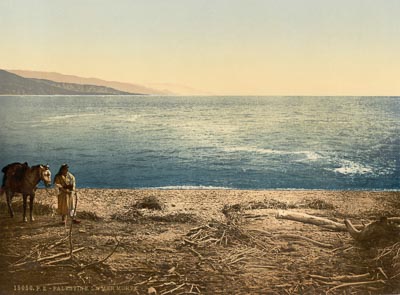
Source: The Holy Land in Photochrom
When a full moon rises, the eastern hills, which gleamed so warm a glow before sunset, are shrouded in gloom, and the moon's radiance shoots over the burnished surface of the lake. There is a stillness that may be felt. Rarely does the wandering Bedouin visit these shores by day, and never by night. The Dead Sea has often been described and still more often been the subject of romance. But let us put aside all preconceived notions, and so long as we do not try to drink it or rub it into our eyes, we shall find a centre of landscape of rare beauty and endless variety. True there is no life, animal or vegetable, within its acrid waters; true that for the like reason its immediate shores are barren; but wherever fresh water approaches it there are nooks of surpassing loveliness and verdure. Such are Engedi, the Safieh, the mouths of the Callirrhoe and the Arnon, and other favoured spots where the fronds of the palm-tree almost lave its brine; and on all sides the cliffs and mountains between which it lies buried are rich in every hue save green. (Source: Picturesque Palestine, vol. 1, pp. 154-55.)
Floating in Dead Sea
In one respect it is a lake without parallel in the world, the deepest depression on the earth's surface, being no less than one thousand three hundred feet below the level of the ocean . . . . It has no outlet, and the volume of water constantly poured into it from the Jordan and the rivers of Moab, as well as by the torrents on the west side and southern end, is carried off simply by evaporation. This alone in the case of a lake without exit would be sufficient to account for its saltness, for the saline particles carried down in solution are not evaporated, but remain, and by their continual additions add to the saltness of the stagnant water. Hence all such lakes are invariably salt. But in this case there is an additional cause in the vast salt deposit several miles long at the south end, Jebel Usdum, past which little streams flow into the sea, bringing fresh supplies of brine . . . . [A]lso in the enormous depth of its water the Dead Sea is unique among lakes. Its greatest depth near the north end is one thousand three hundred and eight feet, and close to the Moab shore it descends sheer for nine hundred feet. The southern portion, on the contrary, on the other side of the Lisan, is only about twelve feet deep. (Source: Picturesque Palestine, vol. 1, pp. 155-156.)
Dead Sea
Source: Earthly Footsteps of the Man of Galilee, p. 153.
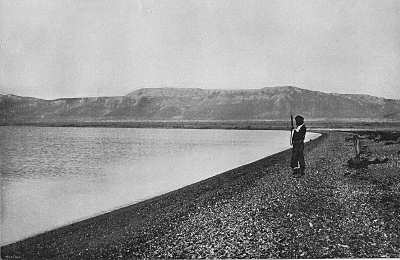
The Arabs call this Bahr Lut, the Sea of Lot. It is the most remarkable inland sea in the world. It is situated in the lowest part of the valley which extends from the base of Hermon to the Gulf of Akabah. The Hebrews call it the Salt Sea. The Greeks at an early period called it the Dead Sea. It is forty-seven miles in length and its greatest width is nine and a half miles . . . . The salt of the Dead Sea has from the earliest times been collected and brought to the Jerusalem markets and is considered particularly strong. To the Government alone belongs all the salt and bitumen brought into and sold in Syria. During the last of April, when the writer and the artist were here, the weather was so hot that it was necessary for us to leave our hotel in Jericho in time to ride to the sea and to the Jordan and back again by ten o'clock in the morning. Dr. H. M. Field writes: "My first impression of the Dead Sea was one of surprise at its beauty. Its very name seemed to be equivalent to the sea of death. Instead of the black waters of death we looked down upon a deep blue expanse that had all the beauty of the Scotch or Swiss lakes." (Source: Earthly Footsteps of the Man of Galilee, p. 153.)
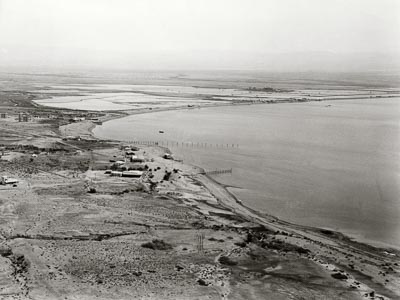
Dead Sea, Aerial View
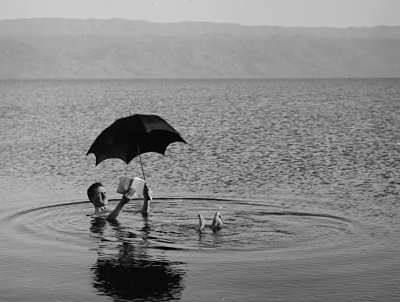
The water of the Dead Sea contains about 25 per cent. of solid matter. Its pungency and saltness cause intense pain to the eyes if it is allowed to enter them, and it is abominably nauseous to the taste; but it is so buoyant that to sink in it is out of the question. One may float on back or breast, sit on the surface as on a feather bed, and-provided one does not fall over head downwards-perform almost any antics without fear of submersion. Swimming, however, is very trying to the small of the back, from the jerk with which the legs fly out on the least attempt to strike out in the ordinary way. The Dead Sea receives the whole torrent of the Jordan, as well as the rivulets and streams from the ravines in the cliffs of Palestine and Moab, on its western and eastern shores. The volume of water thus discharged into it has been calculated at six million tons daily, for which there is no apparent, or, indeed, conceivable outlet, the immense evaporation which takes place being sufficient to maintain the level of the lake. (Source: Picturesque Palestine, vol. 3, pp. 206-7.)
See Bethlehem Church, Rachel's Tomb, Psalm 23, David and Goliath, David the Fugitive, Mar Saba, or Solomon's Pools
At BiblePlaces, see Dead Sea