
Dome of the Rock, Origin
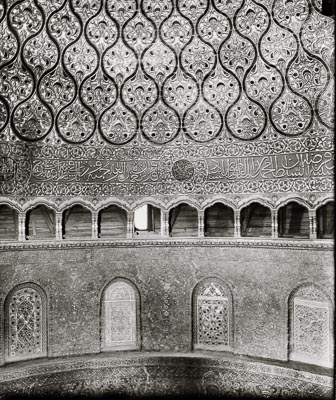
Source: American Colony: Jerusalem
Interior of the Dome
Above the mosaics [inside the building] runs the remarkable inscription, written in letters of gold, which records the erection of the Dome of the Rock by El Mamun in the year 72 of the Hegira. As, however, El Mamun, who was a son of Harun al Reshid, died in 218 A.H., M. de Vogue and Professor Palmer believe that the name of Abd el Melik, who, according to their opinion, was the original founder, was purposely erased, and that of the Imam el Mamun fraudulently substituted; the short-sighted forger, however, omitted to erase the date. The inscription consists chiefly of verses from the Koran. The following are some of the most interesting passages of the inscription: "In the name of God, the Merciful, the Compassionate! The servant of God, Abdallah, the Imam el Mamun, Commander of the Faithful, built this dome in the year 72 (A.D. 691). May God accept it at his hands, and be content with him. Amen! . . ." (Source: Picturesque Palestine, vol. 1, p. 56.)
The Architects
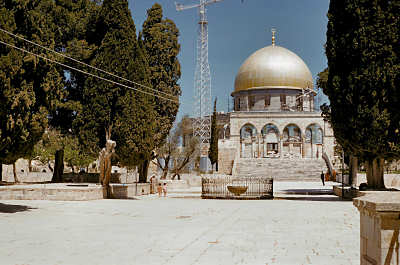
What is the origin of this beautiful building? . . . The conclusions arrived at by a committee of architects and engineers, who considered the question at Munich, seem to have been that the Dome of the Rock was not an old Arab building, and that it could not have been built by Constantine or later than the reign of Justinian. The view of the committee was that the evidence laid before them tended to show that the building could only belong to the first third of the sixth century. The Arab historians attribute the erection of the Dome of the Rock to Abd el Melik, and this is the view generally taken of its origin. The essentially Byzantine character of the building is explained by the supposition that Abd del Melik employed a Greek architect, the Arabs at that time having no style of their own. It is somewhat surprising, however, to find that, though the Arabs came in contact with Byzantine civilization in other places, there is no known instance of a similar style of building having been erected by them. (Source: Picturesque Palestine, vol. 1, pp. 64-65.)
Tradition
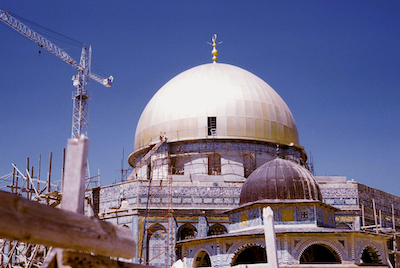
The origin of the mosque, as given by Muslem authorities, is interesting. It is as follows. After taking the city, the Khalif Omar asked where the Jewish Temple stood. The Patriarch took him to this rock, then covered with ruins. Omar, with his own hands, helped to remove the rubbish, and gave orders for the erection of the mosque. It is further said that it was rebuilt in a style of greater splendour by Abd el-Melek, who covered it with plates of gold. During the temporary rule of the Crusaders it was converted into a church, and they called it "The Temple of the Lord." (Source: Jerusalem, Bethany, and Bethlehem, p. 48.)