
Elephantine and Philae Islands
Source: American Colony: Egypt and Sinai
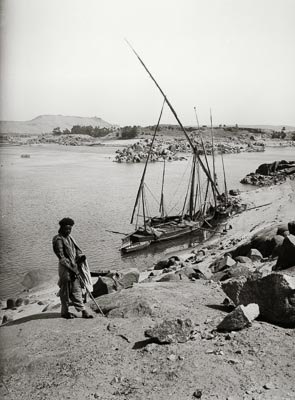
Elephantine Island
Before Aswân is reached the Nile is divided into two streams by the island of Elephantinê, of which it is usual to remark that nothing could be more lovely or verdant. Honesty, however, compels us to admit that these epithets belong rather to the eternal fitness of things than to the particular facts of the case. In any other land but this, where everything is parched and burnt, Elephantinê would be called a barren brown baked little island, saved from decided ugliness by a few patches of green and a picturesque belt of palms . . . . In Egypt, however, it is difficult for the traveller to preserve his mental balance and judge unromantically, and Elephantinê has acquired a factitious charm by a sort of reflected enthusiasm. (Source: Picturesque Palestine, vol. 4, pp. 222-23.)
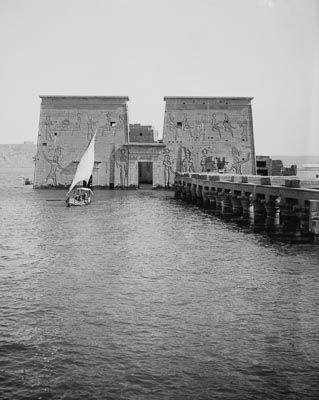
Philae, First Pylon of the Temple of Isis
Source: American Colony: Egypt and Sinai
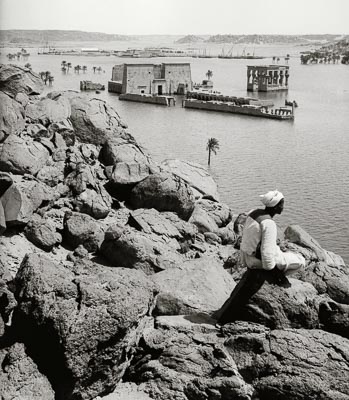
At length we reach the river again; but now we are above the Cataract. A boat is ready and assistance is clamorously proffered, and we row across to Philæ. The approach to the island is very beautiful. On either hand great bare shining rocks, black and grey, tower against the sky, while between them, through an opening, appears the little island, with palms in the foreground, and the well-preserved pylon of the Temple of Isis rising out of the green . . . . Its position is, indeed, almost unrivalled, and there is nothing in Philæ so beautiful as the view from the summit of the larger pylon. The girdling hills that bound the prospect on all sides, the sweep of placid water running under the palms, the savage rocks beyond, all lend an enchantment to the scene which the memories of the island's history serve to enhance. (Source: Picturesque Palestine, vol. 4, pp. 230-31.)
Source: American Colony: Egypt and Sinai
Philae
Philæ does not indeed belong to the great days when a Thothmes or a Rameses conquered distant nations and commemorated his deeds on the walls of his temples. It is the work of Ptolemies and Cæsars. But its associations are more important than its architecture. "It shared with Abydos and some other places the reputation of being the burial-place of Osiris. It was called 'the Holy Island.' Its very soil was sacred. None might land upon its shores, or even approach them too nearly, without permission. To obtain that permission and perform the pilgrimage to the tomb of the god, was to the pious Egyptian what the Mekka pilgrimage is to the pious Mussulman of to-day. The most solemn oath to which he could give utterance was 'By him who sleeps in Philæ.'" (Source: Picturesque Palestine, vol. 4, pp. 231-233.)
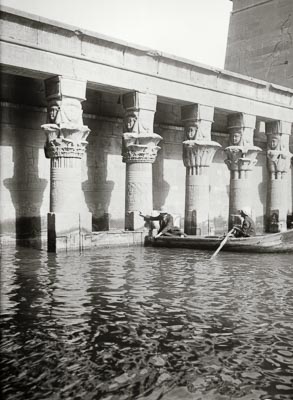
Philae, Birth House at the Temple of Isis
Source: American Colony: Egypt and Sinai
"At length, however, there must have come a day when for the last time the tomb of the god was crowned with flowers and the 'Lamentations of Isis' were recited on the threshold of the sanctuary. And there must have been another day when the cross was carried in triumph up those painted colonnade; and the first Christian mass was chanted in the precincts of the heathen.-A small basilica was built at the lower end of the island, the portico of the great temple was converted into a chapel and dedicated to St. Stephen. 'This good work,' says a Greek inscription traced by some monkish hand of the period, 'was done by the well-beloved of God, the Abbot Bishop Theodore.'-The little basilica, we may be sure, had a cluster of mud huts upon the roof, and I fancy that the abbot and his monks installed themselves in that row of cells in the east side of the great colonnade, where the priests of Isis dwelt before them." (Source: Picturesque Palestine, vol. 4, pp. 233-234.)
See Nile River, Flooding of the Nile River, Water in Egypt, or Giza Pyramids and Sphinx
At BiblePlaces, see Philae Island