
Giza Pyramids and Sphinx
Source: American Colony: Egypt and Sinai
Pyramids of Gizeh
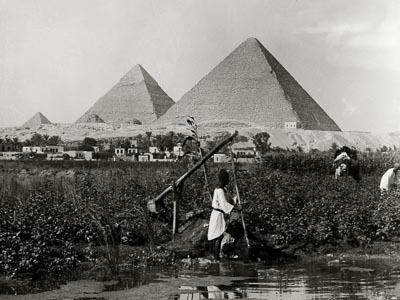
A Pyramid is simply a cairn or barrow, only its stones are laid regularly and their edges are carefully finished, instead of being roughly thrown together. The principle of the Pyramid is almost always the same. A rocky eminence on the desert tract . . . was excavated for the reception of the king's sarcophagus, and a sloping passage was cut to connect the royal sepulchre with the surface. Over the sepulchre, both to protect it from the inroads of the sand and to mark the spot, a large block of stones was erected, almost in the shape of a cube, but slightly tapering towards the top . . . . If the king . . . continued to reign, he . . . put other blocks round the base, so as to form a second stage, upon which he erected another quasicube like the first . . . . The longer the king lived the more numerous these stages became, so that it is possible to gauge roughly the duration of a king's reign by the height of his burial cairn . . . . The entrance to the tomb itself-generally a steep sloping passage, narrow and low-was carefully concealed, and ingenious devices, portcullises, &c., were resorted to in order to prevent the sarcophagus being removed. (Source: Picturesque Palestine, vol. 4, pp. 174-75.)
The King's Chamber
Source: Earthly Footsteps of the Man of Galilee, p. 54
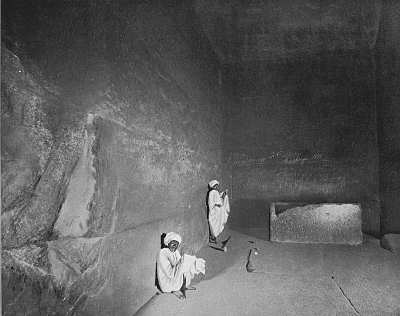
The dimensions of the pyramid of Cheops-the great pyramid-have been variously estimated, but the most accurate measurements ever published were made by Mr. Petrie in 1880-2. The original height he claims was four hundred and eighty-one feet four inches, the actual present height is four hundred and fifty-one feet. The area of the original base was a little more than thirteen acres, and its solid contents have been calculated at eighty-five million cubic feet . . . . The interior of the pyramid has not yet been fully explored, but there is in the heart of it a dark room known as the King's Chamber. The principal apartment, as far as yet explored, is thirty-four feet six inches long, seventeen feet two inches wide and nineteen feet one inch high; the floor is one hundred and forty-one feet from the base of the pyramid. The chamber is lined with granite and roofed with nine enormous slabs of granite, eighteen and a half feet in length . . . . It contains an empty and broken sarcophagus of granite on which there is no inscription, but which undoubtedly contained the body of the king who built it. (Source: Earthly Footsteps of the Man of Galilee, p. 54.)
Source: American Colony: Egypt and Sinai
The Sphinx
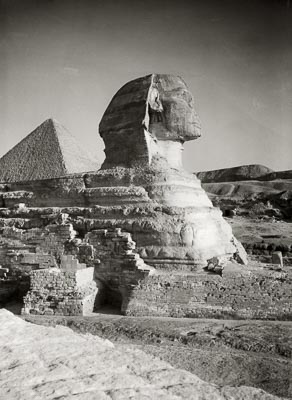
What is the Sphinx? It is the body of a lion couchant, with the head of a man-"a symbol of animal power and of human intellect." The whole figure was typical of kingly royalty and set forth the power and wisdom of the Egyptian monarch . . . . Miss Edwards says, "the sphinx is purely an Egyptian monster and of immemorial antiquity . . . . It is carved out of the summit of the original rock from which it has never been separated. Its body is over one hundred feet long; its head is thirty feet long and fourteen in width; the marks of paint still remain on the face--on the eye-brows and on the right cheek. The face is much mutilated; the body is hidden by drifting sands of the desert; the paws project some fifty feet and in the space between was an altar for sacrificial purposes." . . . From that altar between his paws the smoke went up into the gigantic nostrils now vanished from the face. "The ancient Egyptians called him 'Neb,' 'Lord,' a name generally applied to the gods in their popular pantheon, but specially to the Sphinx alone." (Source: Earthly Footsteps of the Man of Galilee, pp. 50-51.)
Temple of the Sphinx
Source: Earthly Footsteps of the Man of Galilee, p. 52
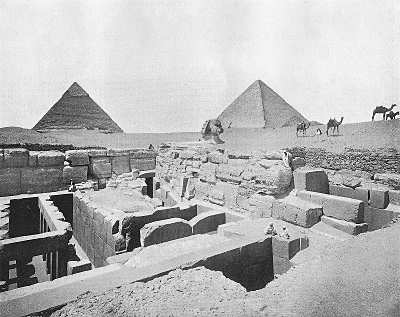
One Egyptologist boldly asserts that "the substructions before the Sphinx are miscalled the Temple of the Sphinx. It is not a temple; it may be a mastaba or votive offering, it looks most like a tomb." The constructions are of plain and polished alabaster and red granite, laid with simplicity. There are four courts, rows of pillars, three principal chambers and dark recesses and a well. The chambers contain niches for the placing of mummies and at the bottom of the well were found three statues of King Kaffra, one of which is the famous portrait statue in the Gizeh Museum, and one is justified in believing that there remain in this vicinity immense quantities of mummies and ancient treasures. It is the opinion of Miss Edwards that here lies the necropolis of the kings of the first and second dynasties buried underneath a hundred feet of sand. (Source: Earthly Footsteps of the Man of Galilee, p. 52.)
See Cairo, Memphis, Mummies, Nile River, Karnak Temple, Luxor Temple, Thebes West Bank, or Elephantine and Philae Islands
At BiblePlaces, see Giza Pyramids