
Houses
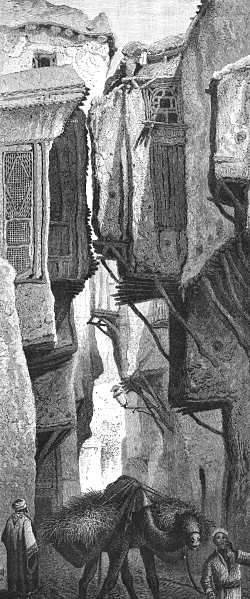
Source: Picturesque Palestine, vol. 2, p. 161
A Narrow By-Way in Damascus
The private houses of Damascus are almost as remarkable for their external plainness as for their internal splendour. A stranger in traversing the city would never guess that it contained such luxurious residences, for they are nearly always situated in tortuous streets with high bare walls on each side; an occasional doorway, more or less decorated, is the only outward and visible sign of their existence . . . . The entrance to a private house is . . . generally only large enough to admit one person at a time, and opens into a passage which, after one or more abrupt turnings, leads into the principal court of the house, which varies in size from fifty to even a hundred and fifty feet square. They are sometimes oblong, and an ordinary-sized court measures eighty feet by fifty. In Muslim establishments the principal court and its surrounding apartments are reserved exclusively for the use of the harem, a smaller court nearer the entrance being used by the master of the house for the reception of his guests . . . . All the rooms round the court open into it, and the windows have no other outlook. (Source: Picturesque Palestine, vol. 2, pp. 164-166.)
Reception Room of a Damascus House
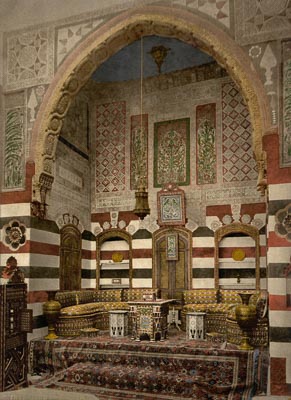
Source: The Holy Land in Photochrom
The walls of a superior house, up to the height of about twenty feet, are built in alternate courses of black and white or black and yellowish-coloured stone, or white stone walls are painted inside and outside in stripes to represent alternate courses . . . . Nearly in the middle of the south side of the court there is always a wide and lofty arched recess or alcove, with slightly raised flooring, and cushioned seats on its three sides. On each side of this there is a closed reception room. The principal one always has a fountain in the lower part of it, which is paved with marble and called the ’Atabeh. Here the guests put off their shoes before they step on to the raised dais, which is cushioned and carpeted, and occupies the larger portion of the apartment. Over the ’Atabeh, in a grand salon, there is usually a clerestory with stained-glass windows; its ceiling should always be higher than that of the daïs. Some idea of the richness of the decoration of a modern house in Damascus may be formed by examining the excellent illustration . . . which represents the ’Atabeh of a reception room. (Source: Picturesque Palestine, vol. 2, pp. 167-168.)
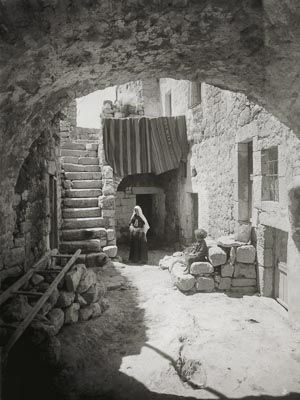
Traditional House in Bethlehem
It is difficult for those who have spent all their lives in a cold, inhospitable Western clime to understand the peculiarities of the East. Orientals pass most of their days and nights in the open air. Except in the cold of winter, the house is used among the middle and lower classes more for privacy than for residence. During nine months in the year to bivouac is, as a rule, a positive luxury. Within, the houses are oppressive, the ventilation is bad, the chambers are rarely, if ever, perfectly clean; so that the terrace roof, or the garden, or the vineyard, or the open hill-side, is far more pleasant for rest and sleep. Travellers generally prefer the balmy air of their tents to the stuffy city hotel. Such has been my experience. And even now, amid the splendours of Western civilization and the luxurious trappings of an English bed-room, I have many a time longed for the freshness and untrammelled freedom of my camp and my tent—even for a bivouac amid the hills of Judah. The clear, starry nights, and early mornings, are wonderfully invigorating. (Source: Jerusalem, Bethany, and Bethlehem, p. 100.)
Summer House in Caesarea Philippi
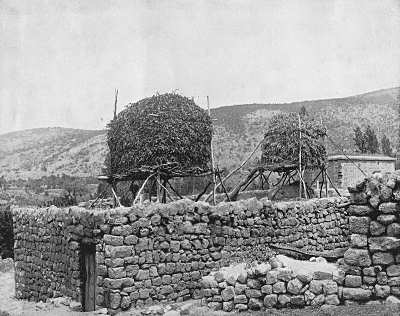
Source: Earthly Footsteps of the Man of Galilee, p. 207
Here are curious structures on the top of low stone houses. The natives in Caesarea Philippi living among the ruins of the ancient city are afraid of scorpions, and the people to escape them during the night build on the top of stone buildings summer houses made of reeds and brush, and into these they crawl to spend the night. They are lifted about two feet on poles above the roof and are said to be very cool and comfortable at night. Summer houses are used only for sleeping purposes. Whatever of cooking is done is in the lower stone apartment. (Source: Earthly Footsteps of the Man of Galilee, p. 207.)
See Marketplace, Cafes and Coffee, Tombs and Burial Customs, Water Supplies, Weddings, Women and Clothing, or Women and Work
At BiblePlaces, see Bethlehem or Caesarea Philippi