
Jaffa (Joppa)
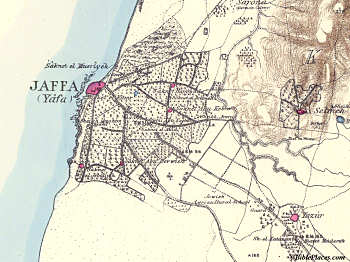
Jaffa
JAFFA, or rather Yâfa, is one of the oldest seaports in the world, and its name has been preserved almost unchanged from the earliest times— . . . Yapho, “the beautiful.” . . . No change has been made in the site of the city [the pink area on the map]: the Jaffa of the present century stands on the accumulated ruins of former cities, on a rounded hill, the summit of which is one hundred and fifty-three feet above the level of the sea . . . . Just in front of the town there is a semicircular belt of rocks, some of which rise high out of the water, while others are only indicated by the surf which dashes over them. These rocks (to one of which, according to Pliny, Andromeda was chained) form a large but shallow harbour, which can only be entered by small boats . . . . There is a wide opening to the north and a narrow one to the west. Steamers anchor in the roadstead half a mile from the shore, and passengers are landed in small boats . . . . (Source: Picturesque Palestine, vol. 3, pp. 139-41.)
Panorama of Jaffa
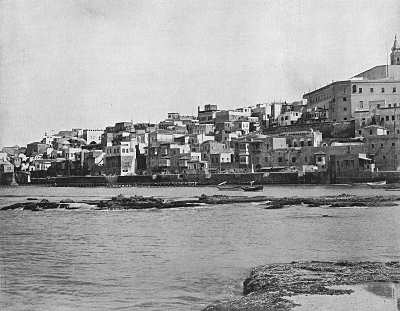
Source: Earthly Footsteps of the Man of Galilee, p. 92.
Jaffa is called "The Port of Jerusalem," but has no proper harbor, and it is only under favorable circumstances of wind and wave that a vessel may come to anchor and ship her freight for the city. There is a little road or enclosure, sometimes called a harbor. It is beyond a dangerous reef that runs parallel with the shore, and the opening through it is only sufficient for one boat, and the noisy surf tumbling about the rocks around him makes the voyager exceedingly glad to reach the little space of quiet water beyond. This was the only harbor possessed by the Jews throughout the greater part of their national existence. There is no other port along the coast and through it nearly all the foreign commerce of the Jews was conducted until the artificial port of Caesarea was built by Herod. Through this road Hiram brought his rafts of fragrant cedar wood and pine for the building of the first temple at Jerusalem; and Cyrus, generations after, used it as a port of entry for the material of the second temple. From various tourists we have thrilling accounts of the landings of travelers. (Source: Earthly Footsteps of the Man of Galilee, p. 93.)
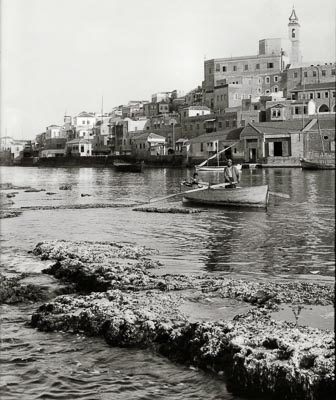
Jaffa's Harbor
[Jaffa] is our first view of ‘Those holy fields, Over whose acres walked those blessed feet Which eighteen hundred years ago were nailed, For our advantage, on the bitter cross.’ A number of boats, manned by half-naked Arabs, howling, yelling, and fighting like demons, cluster round the steamer. In one of them, retained for the use of our party, the fight is so fierce that our dragoman leaps down into it, and lays about him right and left with his heavy korbash. . . . Order being at length restored, we take our seats in the boat, are skilfully steered through a gap in the reef, and soon find ourselves at the foot of some black slimy steps, leading to the Turkish custom-house. A crowd of wretched creatures press round us, clamouring for backshish. The unpaved road is ankle-deep in mud. Foul sights, and yet fouler smells, offend the senses. To most of my companions the sight was altogether new and strange. . . . the disenchantment . . . of the party, as they first set foot on the soil of Palestine, was complete. One American gentleman, who had come prepared to go into ecstasies, and had avowed his intention of falling on his knees on landing, to express his gratitude for being permitted to tread the sacred soil, looked round with a comical expression of bewilderment, and exclaimed, ‘Is this the Holy Land?’ (Source: Those Holy Fields, pp. 12-13.)
Jaffa and Tel Aviv from the South
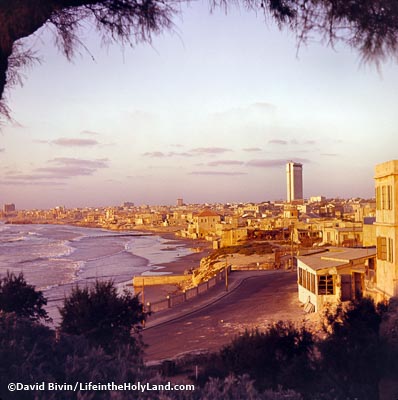
The town of Jaffa is rapidly increasing in wealth and importance. Its population is said to exceed eight thousand, and of this number more than two-thirds are Muhmmedans. The suburban population also is considerable; there is an Egyptian colony north of the town beyond the cemetery . . . , and the Temple colony . . . occupies an estate called Sarôna, some distance to the north-east of it . . . . A very large piece of ground beyond the Jaffa gardens, on the south-east side, has been granted to the Agricultural Colony of the Universal Israelitish Alliance. . . . The domestic architecture of Jaffa . . . resembles that of Jerusalem . . . ; there being very little timber available for building, the roofs are necessarily constructed of stone and are therefore domed. The base of the dome is always more or less concealed by masonry, so that a flat space may be secured for walking upon. These terraced roofs are generally protected by a low wall or parapet, as they must have been anciently in obedience to the law: “When thou buildest a new house, then thou shalt make a battlement for thy roof, that thou bring not blood upon thine house, if any man fall from thence” (Deut. xxii. 8). (Source: Picturesque Palestine, vol. 3, pp. 141-42.)
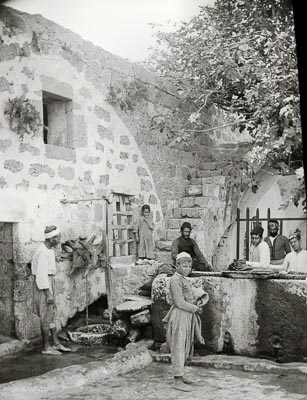
House of Simon the Tanner
From this stand-point we descended to the extreme north-west corner of the city, to visit the house of Simon the Tanner. I felt more interested in this site than I had anticipated. The waves thundering against the rocks at its base gave most emphatic testimony that is ‘is by the sea-side.’ Nobody, of course, pretends that the existing house, with its well and tanner’s slab, is the identical one upon whose roof Peter went ‘to pray about the sixth hour;’ and there falling into a trance, saw heaven open, and heard that voice thrice repeating which prepared him to preach the Gospel of salvation to the heaven world. . . . I see no reason why tradition may not have preserved the knowledge of the site where the miracle occurred. Both Christians and Moslems revere the place, and several of the latter were performing their mid-day prayers on an adjoining terrace while we were there. (Source: Thomson 1880: 33-34.)
See Marketplace, Travel by Sea, Water Supplies, Ramleh, Caesarea, or Peter and Cornelius
At BiblePlaces, see Joppa
Source:
Thomson, William M.
1880 The Land and the Book. Vol. 1: Southern Palestine and Jerusalem. New York: Harper & Brothers.