
Sources of the Jordan River
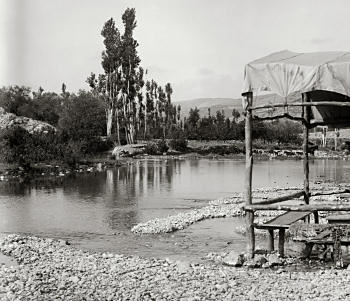
Source of the Jordan at Hasbany
As the most remote and highest source of the Jordan is but half an hour north of Hâsbeiya, one will visit with pleasure the locality where that river of the Holy Land, with which are connected so many sacred associations, actually has its rise. The fountain, like that at Cæsarea Philippi, bursts forth from the foot of a bluff which in this case is of volcanic origin, and sends into the valley a large volume of water. A dam has been thrown across the channel, making a pretty waterfall, which, together with the pond and mill-race, the modern bridge and the old scraggy trees, form quite a romantic spot. (Source: Picturesque Palestine, vol. 2, p. 131.)
Source of the Jordan at Caesarea-Philippi
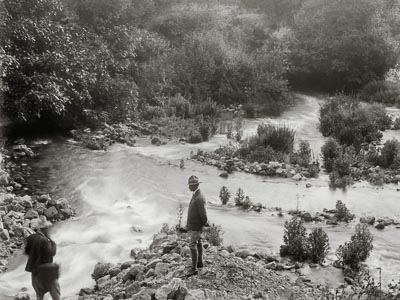
[An]other main source of the Jordan rises at the town of Banias, about four miles from Tell-el-Kadi. At the foot of a limestone cliff is a large cave, formerly dedicated to the god Pan, from which the modern Arabic name of the town is derived. Several niches and dedicatory tablets, with Greek inscriptions cut in the face of the rock, yet remain. Masses of fallen rock and débris obstruct the entrance and bury the actual fountain-head. From beneath these a stream rushes forth in wonderful strength and volume. As at Tell-el-Kadi, it is a river at its source. Only a few yards from the spot at which it emerges from its rocky birth-place, I plunged in, and found myself out of my depth in a current so strong that it was difficult to swim against it. The torrent rushes on over a rocky bed fringed with oleanders, past the ruins of the ancient city, and soon is joined by its sister-stream from Tell-el-Kadi. The Hasbany then falls into it a few miles above Lake Hûleh. The united waters from this point take the familiar name of the Jordan, to pursue their impetuous course till they are lost amid the arid shores of the Dead Sea. (Source: Those Holy Fields, pp. 215-16.)
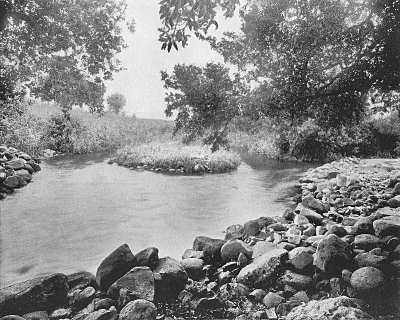
Source: Earthly Footsteps of the Man of Galilee, p. 201
The Jordan at Dan
From the western base of Tell El-Kady bursts forth one of the largest fountains in Syria, and what is said to be the largest single fountain in the world. Its waters form a miniature lake, and then dashing through an oleander thicket and across the plain southward a deep, rapid river. This is called the "lower springs of Jordan." On the eastern side of the mound is a smaller fountain, which springs up within the tell and flows off through a break in the rim on the southwest, and foaming down the bank joins its sister. This is the principal source of the Jordan. . . . The fountain springing from the western side of the mound is supposed to be where the drainage of the southern side of Hermon, pent up between a hard and a soft stratum, seems to have found a collective exit. The waters of the fountains soon unite and wind down the rich plain, both fountain and stream bearing the name El-Seddon, possibly some Arab corruption of Dan. . . . This is the birthplace of the Jordan. It is called the chief of the Jordan from its being the most copious [spring]. It is 504 feet above the sea level and contains twice as much water as the stream from Banias. (Source: Earthly Footsteps of the Man of Galilee, pp. 201, 203.)
See Jordan River, Jordan River Baptisms, Sea of Galilee, Huleh Valley, or Nimrod's Fortress
At BiblePlaces, see Caesarea Philippi and Dan