
Mar Saba
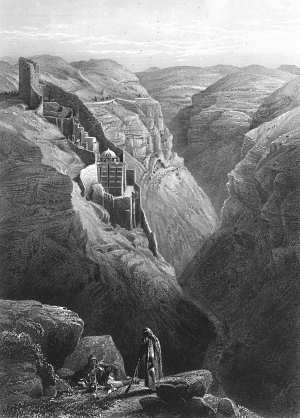
Source: Picturesque Palestine, vol. 1, facing p. 148.
Mar Saba, Valley of the Kedron
. . . after the second captivity we find the caves put to another use. When in the third and fourth centuries the fashion of a hermit life took root in Palestine, the disused sleeping-places of the dead became the homes of the living. A refuge adopted at first, perhaps, from necessity or for security, became an established type of dwelling . . . . When the hermit life became more organized, and the ascetics began to associate themselves in communities, they still retained their attachment to rock-hewn dwellings, and many, though not all, of these "lauras" were formed by a cluster of rock-hewn nests opening into each other. Such is the character of the one remaining unchanged monastery of this type, the famous establishment of Mar Saba, in the Kedron Valley, not far from the Dead Sea. The name "laura" is applied to a number of contiguous but separate cells, each inhabited by a single hermit or anchorite, in contradistinction to a monastery or "coenobium," where the monks live together under the rule of one superior. (Source: Picturesque Palestine, vol. 1, pp. 146-47.)
Mar Saba
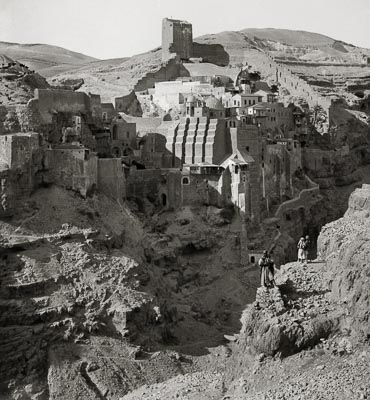
The most difficult, but certainly the finest [route], is that from the Dead Sea, where, soon after reaching the Wady, the whole of the buttresses and towers of the convent come suddenly into view, clustered upon the steep face of the precipitous cliffs, and covering them from top to bottom . . . . A strong wall clings to the side of the rocks the whole way down, effectually protecting the place from any sudden surprise of the Bedouin. From the dry torrent-bed of the ravine flights of steps are cut . . . . The entrance by which travellers are received is marked by a large tower with dilapidated battlements, commanding from its summit a wide prospect, and on which there is always kept a careful lookout . . . . A little iron-barred door is the entrance, where travellers must present their credentials before admission, and where they are carefully scrutinised by the janitor. No Bedouin or ladies are admitted on any pretext, the former for fear of treachery-of which St. Saba's history affords many instances-the latter by the rules of the order. But for their reception a tower outside is provided, where they are supplied with simple fare and a night's lodging. (Source: Picturesque Palestine, vol. 1, p. 148.)
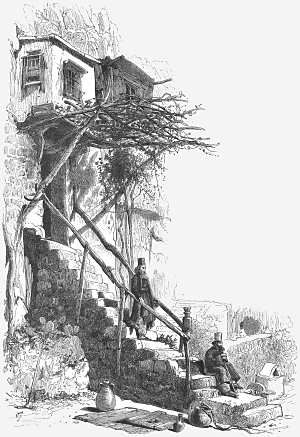
Source: Picturesque Palestine, vol. 1, p. 150.
Entrance to the Cave of St. Saba
The grotto is also shown where St. Saba lived and died, consisting of two chambers, which tradition says he shared peaceably with a lion, who was the original tenant. Three times the lion ejected the saint, but he obstinately returned, and at length the lion contented himself with a shelf in the little inner closet . . . .The library is reputed to contain rare manuscript treasures, but these are not kept to be read or examined; and, with the exception of Curzon and Tischendorf, very few travellers have been able to examine them. Curzon found several MSS. of great interest, among them a copy of the first eight books of the Old Testament, Homer's Iliad on paper, and one ancient Servian MS. All the others were in Greek, and he estimated the number at about one thousand. From the state of some we saw in the cell of the head of the convent, we fear a librarian is much needed here. For better security the key of the library is kept by the Patriarch at Jerusalem. (Source: Picturesque Palestine, vol. 1, pp. 148-150.)
Mar Saba, Belfry with Buttresses on the South Side
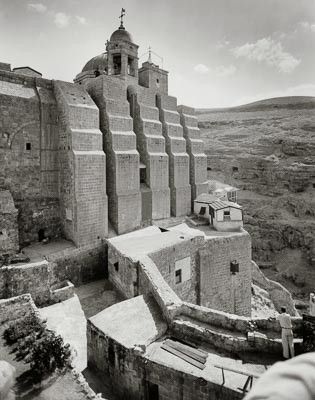
The history of this remarkable settlement begins with St. Euthymius, about A.D. 450. His favourite pupil, St. Saba, born in Cappadocia, A.D. 439, has eclipsed his master's fame. He gathered round him a vast number of anchorites, and formed them into a community under the rule of St. Basil. He was made Archimandrite by the Patriarch of Jerusalem, and in that capacity supported orthodoxy against the monophysitical heresy by driving his opponents, at the head of his armed monks, out of the sacred city. After his feats of arms and controversies he died here in peace, A.D. 532, at the age of ninety-four years. The convent-fortress has been often sacked, especially by Chosroes, the Persian devastator, about A.D. 604, and frequently during the stormy vicissitudes of the Crusading epoch. It was again pillaged during the Syrian troubles in 1834, and was subsequently repaired by Russia. (Source: Picturesque Palestine, vol. 1, pp. 150-151.)
See Monks, St. Catherine's Monastery, Bethlehem, Bethlehem Church, Psalm 23, Shepherds and Flocks, or Bedouin
At BiblePlaces, see Judean Wilderness