
Marketplace
Source: Earthly Footsteps of the Man of Galilee, p. 95
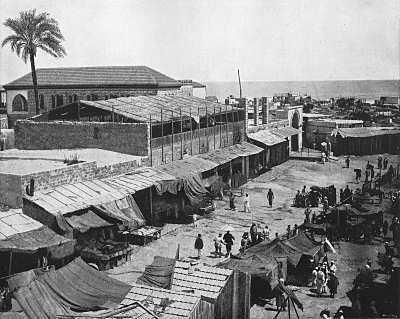
Bazaar at Jaffa
The liveliest spot in the city is the market place. Here the venders, dressed in unique costumes, raise their canvassed canopy, spread out their wares, sit in the shade and wait for custom. Turbaned men and veiled women; with here and there a little brown-skinned, bare footed boy among them, move in and out among the booths. Heavily laden camels go slowly along, and over-burdened donkeys do their share in this bewildering march. It is a veritable Oriental fair, a Babel of confusion; every one for himself and each ambitious to make the loudest possible noise. Here are exposed for sale oranges, pomegranates, quinces, apricots and all kinds of vegetables in their season. The Fellahins, also from the villages, bring here their sheep and goats, lambs and kids, cows and calves, milk, butter and cheese, poultry and eggs, figs, olives and every other kind of fruit, fresh or dried, which they have to sell. (Source: Earthly Footsteps of the Man of Galilee, p. 95.)
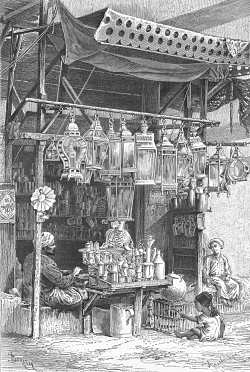
Dealer in Lanterns, Joppa
Source: Jerusalem, Bethany, and Bethlehem, p. vii.
On my way back to the gate I passed an open shop, where dealers in beads from Bethlehem, and relics from the Holy Sepulchre, and ornaments of olive-wood and mother-of-pearl, were busily engaged vending their wares. They never think of rising when a customer appears. They sit high on a shelf of their raised stall, and quietly reach for anything that may be asked for. (Source: Jerusalem, Bethany, and Bethlehem, pp. vi, ix.)
Source: Picturesque Palestine, vol. 1, p. 32
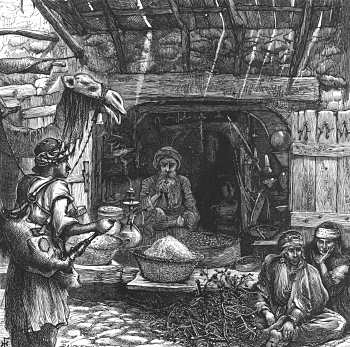
A Grocer's Shop, Jerusalem
The grocer in his striped gown and coloured turban sits on his shop-board quietly smoking, for it is nearly midday, and there is not much business to attend to. His stock consists of baskets of Egyptian rice and rice from the Jordan, a good supply of loaf sugar and coffee, dried fruits, pistachio nuts, walnuts, olives, salt, pepper, and all kinds of spices. A laden camel is just coming into the picture, making a growling noise and ringing his bells. . . . In advance of the camel comes a water-carrier from Siloam, with a patched goatskin filled with water from the Bir Eyub (Job's Well). He rattles his brass cups, and cries out in a shrill voice, "May God compassionate me!" Two peasant women with dishevelled hair and yellow kerchiefs bound round their stiff red cloth caps are resting near the shop. They have rings in their noses and on their fingers, but their feet are bare. (Source: Picturesque Palestine, vol. 1, p. 36.)
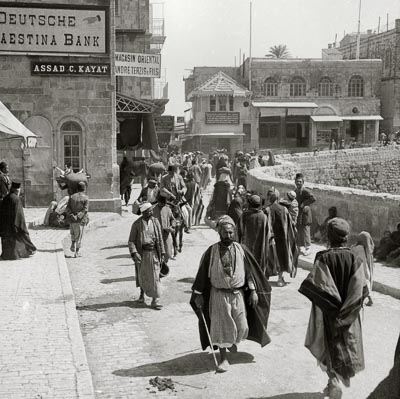
David Street Inside Jaffa Gate
Source: American Colony: Jerusalem
A favourite site for a bivouac is the open space just within the Jaffa Gate; but pilgrims and wayfarers who select this spot must move at a very early hour in the morning, to make way for the peasants who come from the neighbouring villages with daily supplies of fruit, vegetables, and poultry for Jerusalem. . . . Soon the place is crowded, and the bustle of buying and selling begins. No purchase is effected without a considerable amount of contention. The seller does not usually price the goods, but waits for an offer. The first offer is always absurdly low. The seller then names an exorbitantly high price. For instance, a dignified-looking shopkeeper, wearing a white turban, will offer three piastres for a large basket full of tomatoes. The girl in charge answers indignantly, "I will carry my tomatoes back to Siloam rather than take less than fifteen!" - "O thou most greedy of the greedy, I will give no more than six!" - "O possessor of a tightly closed hand, I will not take less than twelve! How shall I buy the rice for my mother if I give away the fruits of her garden?" Finally she obtains seven and a half piastres for her tomatoes, and goes away perfectly satisfied, having argued with pertinacity for the half piastre. (Source: Picturesque Palestine, vol. 1, pp. 32, 34.)