
Mosques
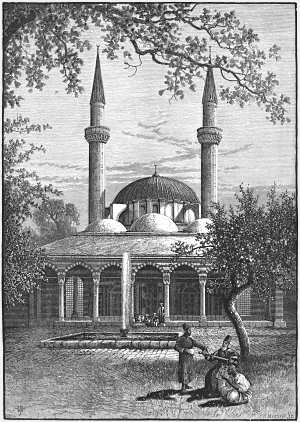
Source: Picturesque Palestine, vol. 2, p. 165
Mosque of the Tekiyeh, or Hospice of the Sultan Selim
The designs of mosques vary considerably, especially if they are built to contain the founder's tomb; but the fundamental idea is always the same-an open court surrounded by a covered cloister-and the main variation consists in converting the four cloistered sides into four deep transepts . . . resulting in a cruciform interior, whilst the squares left between the four transepts are filled up by additional chambers, schools, fountains, &c. (Source: Picturesque Palestine, vol. 4, pp. 152-53.)
Mosque of Amr's Interior
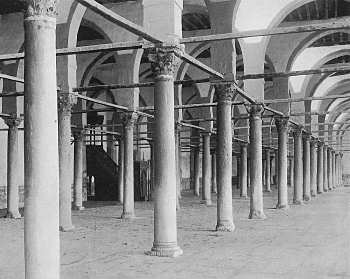
Source: Earthly Footsteps of the Man of Galilee, p. 69
In either case, whether the court be surrounded by cloisters with double rows of columns supporting pointed arches on which the heavy carved beams of the flat ceiling rest, or by four transepts with vaulted roofs and only one grand arch to each, the cloister or transept to the east (i.e. towards Mekkah) is deeper than the other three, has more than two rows of columns, or is separated by a carved screen from the court. This is the sanctuary (lîwân). (Source: Picturesque Palestine, vol. 4, pp. 153-54.)
Source: American Colony: Jerusalem
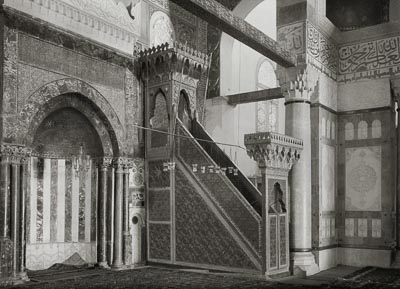
Pulpit of Al Aqsa Mosquek
The floor is raised, and on it the worshippers prostrate themselves, with their faces turned to the niche (mihrâb) in the centre of the east wall, which marks the kibleh or direction of Mekkah. This niche is generally the chief point for decoration; it is usually constructed of inlaid marble and mother-of-pearl, and framed with exquisite borders of Arabic inscriptions. On the right of the niche is the pulpit, a staircase generally constructed of geometrically panelled wood, inlaid with ivory and adorned with inscriptions. Near the front of the sanctuary is the platform, resting on dwarf columns, generally very plain and simple, where the Koran is read aloud. (Source: Picturesque Palestine, vol. 4, p. 154.)
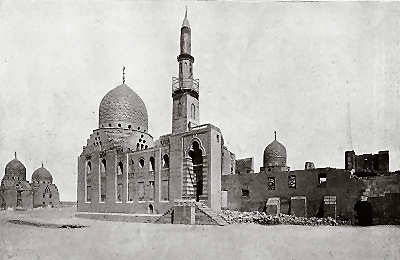
Tomb of Sultan Barkuk
Source: Earthly Footsteps of the Man of Galilee, p. 63
If there is a founder's tomb, it is generally behind or at the side of the sanctuary; and as a rule over it, or over the sanctuary, rises the dome, which, though borrowed from the Byzantines, has been so completely naturalised as to form the most characteristic feature in Arabian architecture. Perhaps the bulb-shaped dome reminded the Arabs of their primæval tent, and the minaret recalled the palm-tree up which the first muëddin clomb to chant the call to prayer. The minarets rise from the corners of the cloisters or near the portal of the cruciform mosque, but their position, like their number, is very variable. The exterior of a mosque is either quite plain or slightly decorated with mouldings and inscriptional friezes, and sometimes the whole building is enclosed by a brick wall and outer courts to isolate the devotions of the people from the noises outside. (Source: Picturesque Palestine, vol. 4, pp. 154-55.)
See Arabs, Bedouin, Muslim Customs, Muslim Religious Practices, or Cairo
At BiblePlaces, see Dome of the Rock