
The Mount of Olives
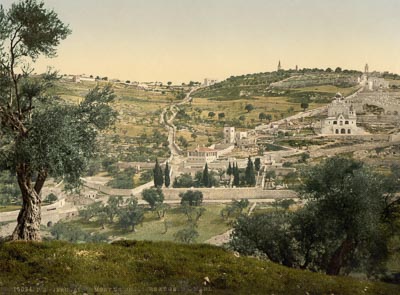
Source: The Holy Land in Photochrom
Mount of Olives
Immediately beyond the Kedron Valley, "before" or to the east of Jerusalem, is the Mount of Olives . . . a long ridge of graceful outline, swelling out ever and again into rounded knolls which command striking views of the city and the surrounding country. On one of these knolls, opposite Mount Moriah, and two hundred and twenty feet above the Temple Platform, are the Mosque and Church of the Ascension; on another, towards the north, a small ruin marks the spot where, according to tradition, the men of Galilee stood "gazing up into heaven" (Acts i. 11); and still farther northward is Scopus, the brow of the hill whence Titus and his legions looked down upon the doomed city . . . . The ride from Scopus along the crest of Olivet to the Church of the Ascension is one of the greatest interest and beauty: on one side there are ever-changing views of the deep depression of the Jordan Valley and the Dead Sea; on the other, every step brings more prominently to view some spot, or it may be some building, which no thoughtful man can look upon without at least a passing emotion. (Source: Picturesque Palestine, vol. 1, pp. 3-4.)
Mount of Olives from Zion's Gate
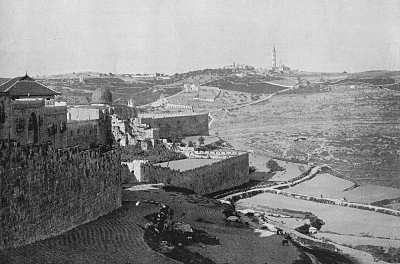
Source: Earthly Footsteps of the Man of Galilee, p. 225.
The traveller, on approaching from the west, is grievously disappointed at the first view . . . . He naturally looks for the Mount of Olives, which, above all other hills, has fixed itself in his mind; and perhaps, in reply to an eager question, the guide points to a gray, wavy line beyond the city, and scarcely overtopping the buildings. Though a mile distant, the air is so transparent and the colouring so uniform that it seems close at hand. Then, besides, it has no striking features,-in fact, it may be said to have no features at all. Yet this is Olivet, one of the grandest centres of sacred and historic associations. Photographs in an Eastern climate show those artistic defects somewhat too clearly, and consequently they are generally flat and uninteresting. I have seen many sketches, but, as a rule, the imagination of the artist has exaggerated both the apparent distance and the elevations, and thus truth is sacrificed to effect. (Source: Jerusalem, Bethany, and Bethlehem, pp. 15-16.)
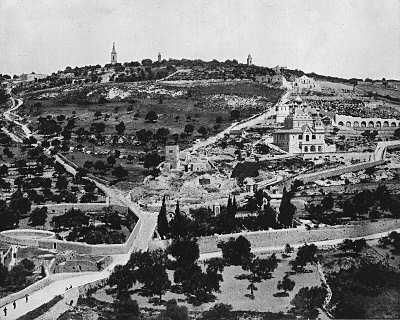
Source: Earthly Footsteps of the Man of Galilee, p. 127.
Mount of Olives
Let us, from our point of view on the hills of Jerusalem, look eastward and see the Mount of Olives, always conspicuous from every part of the environs of Jerusalem. There are three ways of ascending the Mount of Olives. At the bottom of the picture to the left we see the main road coming down from the St. Stephen's Gate, behind us, into the heart of the valley. Immediately before us, with its dark and tapering trees, is the Garden of Gethsemane. To the left a road goes up the Mount of Olives. This is thought by some to be the way that David passed when fleeing from his rebel son Absalom. Then we see the middle road, which, in the picture, turns to the southeast and ascends the mount to the left of the new Greek church with its towers of swelling domes. This road passes to Bethany, over the summit of the hill. Another road, passing this side of the Garden of Gethsemane, at the bottom of the picture, is the carriage road which leads to Bethany. (Source: Earthly Footsteps of the Man of Galilee, p. 127.)
Dome of Ascension, Mount of Olives
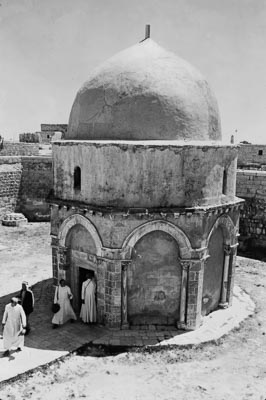
Source: American Colony: Jerusalem
The top of the Mount of Olives is the traditional scene of the Ascension, and a church was built over it in the fourth century, by Helena, the mother of Constantine. That building has long since disappeared, and the reputed site is now occupied by a humble chapel which stands in the court of a mosque! Crowds of pilgrims visit it, and have done so for many centuries. The guardian shows them the print of one of the Saviour's feet in the rock, and tells them that both footprints were there until the Mohammedans stole one of them. Bishop Ellicott and others think the traditional may be the true site of the Ascension; but I cannot see how the words "as far as to Bethany" can be made to signify, to the top of Olivet, which is not half-way to that village. (Source: Jerusalem, Bethany, and Bethlehem, p. 107.)
See Garden of Gethsemane, Temple Mount, Old City Gates, or Church of the Holy Sepulcher
At BiblePlaces, see Mount of Olives