
Muslim Religious Practices
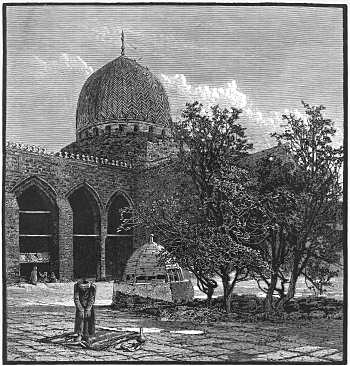
Source: Picturesque Palestine, vol. 4, p. 145
Court of the Tomb-Mosque of Barkuk
Mohammedan worship is very simple, and resembles that of the Jewish synagogue. It consists of prayer, reading of the Koran, and preaching. The second commandment is strictly understood as an absolute prohibition of all image-worship and of all representations of living creatures, whether in churches or elsewhere. The Arabesque is the only ornament allowed, and always taken from inanimate nature. The mosques, like Catholic churches, are always open and frequented by worshippers, who perform their devotions either alone or in groups with covered heads and bare feet. In entering, one must take off his shoes, remembering the command, "Put off thy shoes from off thy feet, for the place whereon thou standest is holy ground." . . . The mosques are as well filled with men as many Christian churches are with women. Islâm is a religion for men; women are of no account; the education and elevation of the female sex would destroy the system. (Source: Picturesque Palestine, vol. 2, p. 184.)
Umayyad Mosque, Damascus

In Damascus there are seventy large or, as they may be called, cathedral mosques (Jami'a), in which sermons are preached and congregational prayers are offered up for the reigning Sultan every Friday. Besides these there are about one hundred and eighty Muslim oratories or chapels (Mesjîd), to many of which schools are attached. Prayers are also frequently said at the grated windows of the little shrines or tomb-houses of celebrated welys, or saints, which are numerous in Damascus. Men of the higher classes rarely go to the mosques except on Fridays, as they can command proper places for ceremonial ablution and prayer in their own houses; but to a Muslim of the lower ranks, a large mosque which is open every day from sunrise to sunset or later, is like a second home. In its courts or cloisters he may not only rest and sleep, or read . . . but he may take his food and eat it there, and even pursue any cleanly and simple avocation. Notwithstanding this liberty the greatest decorum is observed. (Source: Picturesque Palestine, vol. 2, p. 148.)
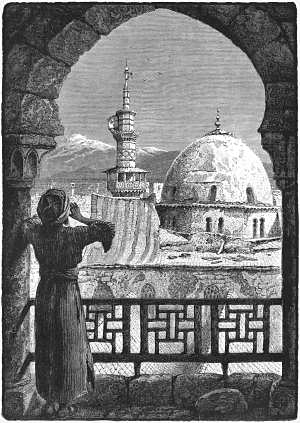
Source: Picturesque Palestine, vol. 2, p. 147
A Meuddin Chanting the Call to Prayer from a Gallery of the Minaret of 'Isa (Jesus)
There are five stated seasons for prayer-at daybreak, near noon, in the afternoon, a little after sunset (to avoid the appearance of sun-worship), and at nightfall, besides two night prayers for extra devotion. The muëddin, or muezzin (crier), announces the time of devotion from the minaret of the mosque by chanting the "Adan," or call to prayer, in these words: "God is most great. I testify that there is no deity but God. I testify that Mohammed is God's apostle. Come to prayer! Come to security! Prayer is better than sleep! God is most great! There is no deity but God!" (Source: Picturesque Palestine, vol. 2, p. 184.)
Muslem Praying
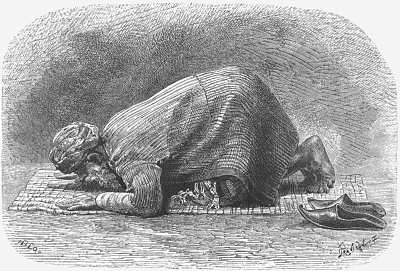
Source: Jerusalem, Bethany, and Bethlehem, p. 52
A devout Mussulman is never ashamed to perform his devotion in public-whether at home, or in the mosque, or in the street, or on board the ship. Regardless of the surroundings, feeling alone with God in the midst of the crowd, he spreads his rug, goes through his genuflexions and prostrations, his face turned to Mecca, his hands now raised to heaven, then laid on the lap, his forehead touching the ground, and repeats the first surah of the Koran, and the ninety-nine beautiful names of Allah, which form his rosary. (Source: Picturesque Palestine, vol. 2, p. 184.)
See Arabs, Bedouin, Muslim Customs, Mosques, Jews, Samaritans
At BiblePlaces, see Dome of the Rock