
Ramleh and the Tower of Martyrs
Source: Earthly Footsteps of the Man of Galilee, p. 88.
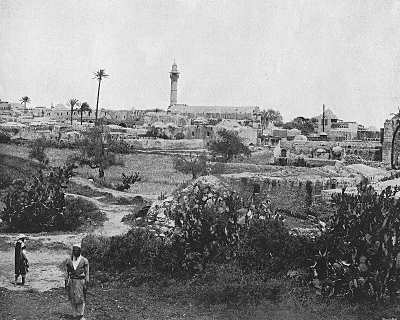
General View of Ramleh
Ramleh (signifying sand) is a name of purely Arabic origin. The town was founded in 716 by the Mayyad Khalif Suleiman, the son of Abd el-Melik. Ramleh is three miles southwest of Lydda, at the intersection of the great roads from Damascus to Egypt, and from Jaffa to Jerusalem. Edrisi, in the XIIth Century, calls Ramleh and Jerusalem the two principal cities of Palestine. Its position made it a place of importance during the wars of the Crusades. Ramleh was once fortified and had four large and eight smaller gates. Christians lived there, and churches were built before the time of the Crusades. In 1099 a bishopric of Lydda and Ramleh was established. During the wars between the Franks and Saladin, Ramleh was twice taken by the Saracens. After 1266, when it was wrested from the Franks by Beibars, it was wholly occupied by Moslems. Near the close of the XVth Century it fell entirely into decay and is now a village of about 3,000 inhabitants---two-thirds Moslems and the rest Christians. It now contains few buildings or ruins earlier than the times of the Crusades. (Source: Earthly Footsteps of the Man of Galilee, p. 88.)
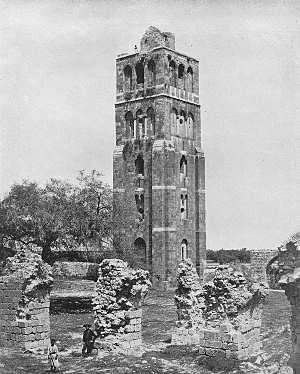
Tower of Forty Martyrs
Source: Earthly Footsteps of the Man of Galilee, p. 89.
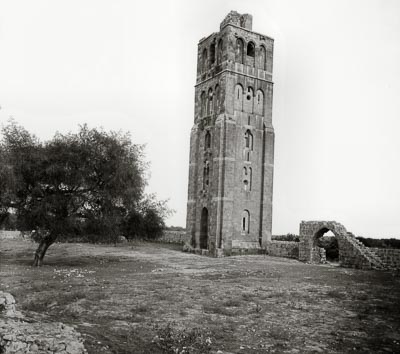
The Tower of Ramleh (Jami el Abyad) known by various names, as the White Mosque, White Tower, Tower of the Forty Martyrs--and by the Moslems, Tomb of the Forty Champions--stands on high ground about a quarter of a mile from the town of Ramleh. Around it are the remains of a large quadrangular enclosure--once, doubtless, a spacious Khan. The tower is now isolated, but there can be little doubt that it was once attached to a mosque. The tower is Saracenic, square, and beautifully built. The angles are supported by slender buttresses, and the sides taper upwards in stories. A winding staircase, lighted by pointed windows, leads to the top, opening on an external stone gallery, which is carried around the tower. The height is about 120 feet. Migr ed Dili ascribes the building of the tower to Masir Muhammed ibu Kalawuu, Khalif of Egypt. He is believed to have begun it A.D. 1310, and finished it in eight years. (Source: Earthly Footsteps of the Man of Galilee, p. 89.)
Tower of Ramleh
An extended and beautiful view is obtained from the gallery of the tower. "Orchards and olive groves of Ramleh lie at our feet; on the northeast they are touched by those of Lydda, which is seen seated on a gentle eminence. Beyond these, north and south, the eye wanders over a boundless plain, tinted according to the season, with the verdure of spring, or the golden hue of early summer, or the unvarying gray of autumn. On the west is the sea, and on the east the 'Mountains of Israel.'" There is a Mohammedan tradition to the effect that forty companions of the prophet are buried in the vaults of the mosque. The Christian version has it that forty Christian martyrs of Cappadocia, repose here. Conder gives a first impression of Ramleh thus: "We arrived before sundown in sight of the tower, which is first visible from a rise of ground on the road. The long olive groves here formed a dark oasis in the treeless plain, and above them rose the beautiful tower of the Forty." (Source: Earthly Footsteps of the Man of Galilee, p. 89.)
Plain of Sharon from the Tower
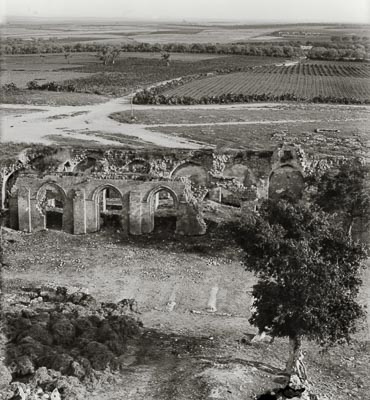
The traveller who, on arrival at Ramleh at sunset, can forget his fatigue and accomplish the ascent of the lofty tower overlooking the plains . . . will be amply rewarded for his exertions by the magnificent view spread out before him . . . . Though yet early in the year, the winter is past, the rain is over and gone. “The flowers appear on the earth, the time of the singing of birds is come, and the voice of the turtle is heard in our land. The fig-tree putteth forth her green figs, and the vines with the tender grapes give a good smell.” The fragrance from the orange-groves is wafted on the breeze, the last lowing of cattle and bleating of sheep returning to their folds fill the air with a pleasant sound—darkness and quiet are spreading over the land. . . . The whole goodly plain of Sharon is visible—from Mount Carmel on the north down to Lydda, from the eastern hills to the blue sea, now bathed in gold—a wilderness of weeds and thorn brakes, and yet a very paradise of colour and ever-varying beauty. (Source: Picturesque Palestine, vol. 3, pp. 145-46.)