
Sea of Galilee
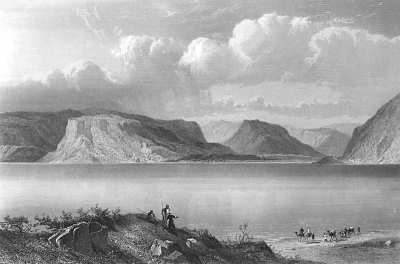
Source: Picturesque Palestine, vol. 2, facing p. 72.
The Sea of Galilee from the Heights of Safed
One of the most charming views on earth is the Sea of Galilee as beheld from this ancient castle [at Safad]. It appears to be at our very feet, although it is eight or ten miles away. It lies in a deep basin fully three thousand five hundred feet below where we are standing, and its surface is bright beneath the blue sky. Beautiful and quiet, and surrounded by picturesque hills, it has more the appearance of a work of art than of a natural lake; and one ceases to wonder at the extravagant praises bestowed upon it by the ancient Hebrews, since it was justly the pride of their land. (Source: Picturesque Palestine, vol. 2, p. 74.)
Sea of Galilee with Tabgha, the Supposed Site of Bethsaida
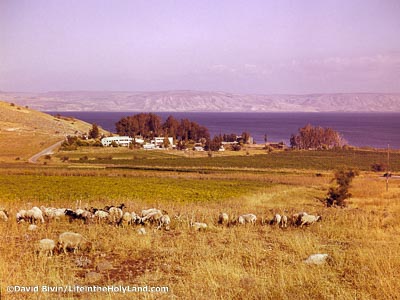
The ride along the sea to Tiberias is a pleasant one, and occupies about one hour. If the weather is favourable for boats, a white sail may occasionally be seen far out on the lake, for the traditional "one boat" has increased to half-a-dozen or more . . . . Still the number is very limited, there being no business to support them . . . . From a passage in Josephus ("Wars," iii. 10, 6), we infer that ship-building was one of the important industries of Tarichæa. And, "when we add to the fishermen the crowd of shipbuilders, the many boats of traffic, pleasure, and passage, we see that the whole basin must have been a focus of life and energy, the surface of the lake constantly dotted with the white sails of vessels flying before the mountain-gusts, as the beach sparkled with the houses and palaces, the synagogues and the temples, of the Jewish or Roman inhabitants" (Source: Picturesque Palestine, vol. 2, pp. 70, 72.)
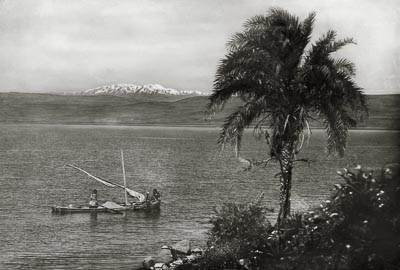
The Sea of Galilee
This sea is called the Sea of Galilee because it is embraced in the province by that name. It is called the Sea of Tiberias because this is the largest city on its shores. It is called the Sea of Genesaret because of the fertile plain which skirts its western shore. . . . Here lies before us the scene of so many of our Savior's miracles and teachings. In the times when Christ was here the cities were very numerous. According to Josephus, the smallest of them contained more than fifteen thousand inhabitants. The waters of this lake were plowed by four thousand vessels of every description, from the war vessel of the Romans to the rough fishing smack of Bethsaida and the gilded pinnace from Herod's palace . . . . The view before us is very impressive; a strong wind has been blowing and the restless waters dash against the rocky shore, washing the ruins of the old docks. Beyond are the hills resting in soft light and above the overarching heavens, bluer than the sea and full of beauty and benediction. (Source: Earthly Footsteps of the Man of Galilee, p. 169.)
The Sea of Galilee from the Wall of Tiberias
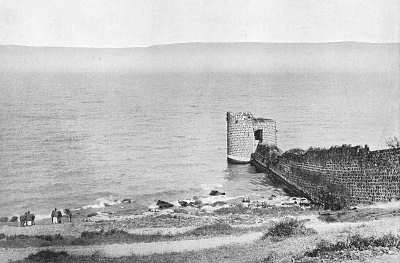
Source: Earthly Footsteps of the Man of Galilee, p. 178.
In Christ's time the region about the Sea of Galilee was thronged with intelligent, busy men, and covered with the marks of civilisation and prosperity. But all is changed; and the only signs of life at present are a few boats on the lake, a few ploughmen in the fields, and the cattle or tents of the Bedawin on these sacred hillsides. Still, although in desolation, this region is to us one of the most delightful places on earth. No church or cathedral in civilised lands brings us so near to the Divine Master as a day spent on these lonely shores . . . .We have been across it many times, and examined every locality north and south of it, and on both the eastern and western banks; we have seen it in calm and storm, in summer and winter; and its beauty grows upon us . . . . And he who goes from point to point about this hallowed lake, and observes the changing aspects of sea and mountains, will find its scenery to be diversified instead of monotonous and uniform, and that some of its views possess elements of unusual loveliness and grandeur. (Source: Picturesque Palestine, vol. 2, p. 88.)
See Bethsaida, Beth Shean, Capernaum, Huleh Valley, Jordan River Sources, Tiberias, or Fishing and Fishermen
At BiblePlaces, see Sea of Galilee