
Solomon's Pools
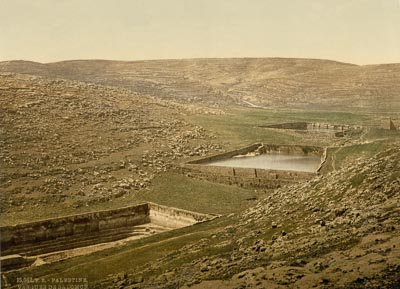
Source: The Holy Land in Photochrom
Pools of Solomon
We now pass up the tiny glen to El Burâk (Solomon's Pools), by the side of the direct road from Bethlehem to Hebron . . . . Immediately on leaving the enclosed gardens barrenness resumes its sway. The valley was once full of oaks of large size, and stumps may here and there be seen, now sought for and dug up for firewood. The pools are marked at a distance by the great square castle at the north-west corner of the upper one-a late Saracenic structure serving the purposes of khan and barracks for a few soldiers. The pools are three in number and in steps, each at a considerably lower level than the one above it, and are formed by walls of massive masonry stretching across the valley. They are chiefly hewn out of the native rock, the upper one especially being considerably heightened by masonry strengthened by buttresses. (Source: Picturesque Palestine, vol. 1, p. 139.)
Solomon's Pools, Lower Pool
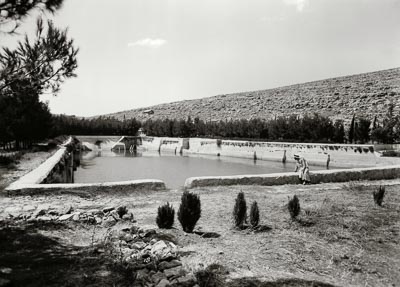
A short ride up the glen from Urtas brings us to a basin-shaped depression in the mountain-range, in the bottom of which lie Solomon's Pools. They are partly excavated in the rocky bed of the vale and partly built of large hewn stones. They are three in number, of great size-each being nearly one hundred and fifty yards long, by half as much in breadth, and about forty feet deep. They are so arranged on the natural slope of the ground that the bottom of the upper pool is higher than the surface of the next, the object evidently being to collect and store the greatest possible quantity of water. The source from which they are supplied is a subterranean fountain some distance above them on the hill-side. The only visible mark of this fountain is an opening like the mouth of a well, generally covered with a large stone. The internal arrangements are very ingenious, and give one the impression that the intention was to conceal the spring. (Source: Jerusalem, Bethany, and Bethlehem, p. 132.)
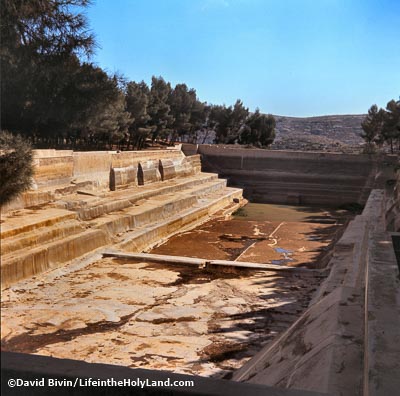
Solomon's Pools, Lower Pool
The first pool below the castle is 380 feet long and 25 feet deep, with a breadth on the west end of 229 feet and on the east end of 236 feet. About 50 yards below the first pool is the second, the top of which is a little lower than the bottom of the first. This pool is 423 feet long, 39 deep, and at the west end 229 feet wide, and at the east end 236 feet wide. The lowest pool is 248 feet from the middle pool, and its length is 582 feet. It is 50 feet deep, its breath on the west end is 148 feet and on the east end 207 feet. The pools are all widest at the lower end . . . . This is a cheerful country, and birds sing in the green coppices of oak on either side, and flocks may be seen going to the pools for water. (Source: Earthly Footsteps of the Man of Galilee, p. 140.)
Solomon's Pools
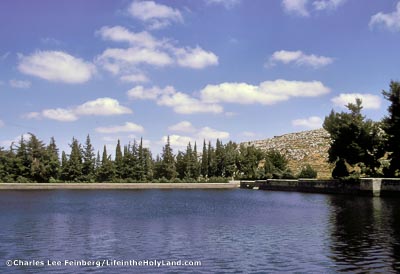
We can see at once the reason for constructing three basins, for a single reservoir to hold so large a supply would have demanded an embankment of enormous strength. . . . To enable the pools to be cleaned and water to be drawn on the spot when not quite full, there are flights of stairs inside the lower end of each. Not only are the supplies from several springs, near and distant, carefully conducted by subterranean channels into the pools, but there are also channels for the collection and conveyance of rain-water, so that nothing shall be lost. (Source: Picturesque Palestine, vol. 1, p. 139.)
See Water Systems in Jerusalem, Hezekiah's Pool, Pool of Siloam, Bethlehem, or the Dead Sea
At BiblePlaces, see Warren's Shaft, The Pool of Siloam, or Hezekiah's Tunnel