
Vineyard and Grape Pressing
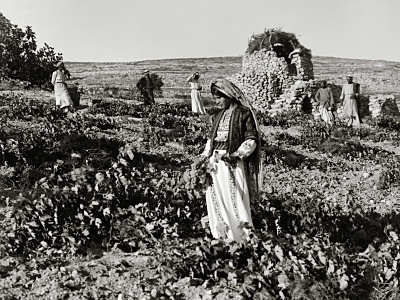
Gathering Grapes in a Vineyard
Life in the vineyards in the summer months is certainly a time when a good deal
of care is done away with. It is pleasant living, fruits to eat, no house
sweeping, and all kinds of housework reduced to the least. (Source:
Baldensperger 1901: 70.)
A newly planted vineyard will bear fruit in three years. All kinds of fruit
trees as well as vines are planted in the vineyards--fig-trees, pomegranate,
apple, pear, apricot, peach, quince, and mulberry trees. Directly the fruit is
of any size the owner's family watch over it, and as soon as it becomes eatable
they take up their abode at the vineyard, and remain there until it is all over.
Everyone tries to pass some weeks or months during the hot unwholesome summer in
a vineyard. (Source: Klein 1883: 46.)
Watch Tower in Vineyard
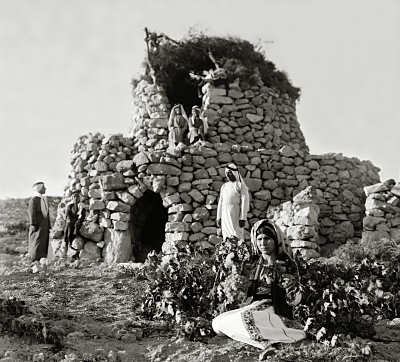
A watch-tower is built in the vineyards,
generally of large stones without mortar, and
on the top of it is a little hut roofed with
branches. From this coign of vantage the
vineyard can be overlooked and watched; near
it there is often an arbour formed of rough
tree stems, and covered with vines.
(Source: Klein 1883: 46.)
The vineyards are always surrounded by a dry
stone wall and a kasr built in it. On the top
of this loose-stone building they put a hut,
which in summer only is covered by branches.
Here the family lives, and from this elevated
place the guardian can survey the vineyard,
which, though fenced all round with
thorn-bushes laid on the wall, is often
visited by foxes, badgers, jackals, and
sometimes thieves. (Source:
Baldensperger 1908: 293.)
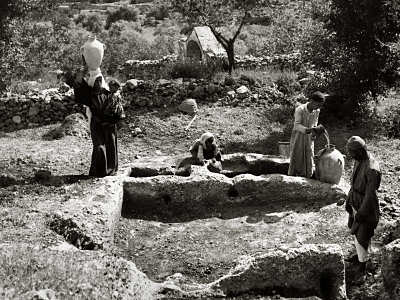
Ein Karem, Ancient Winepress, Natives with Middle Bronze Jars
The grapes were not carried home, but the wine was expressed on the spot, every vineyard possessing its own winepress. It consisted of two vats, hewn one below the other out of the solid rock, on the slope of the hill. At the upper end a trough was cut, about three feet deep and four and a half by three and a half feet in length and breadth. The second trough was smaller, about four feet by three feet, and from twelve to eighteen inches in depth. The two were connected by two or three small holes bored through the rock, close to the bottom of the upper trough, so that, on the grapes being put in and pressed down, the juice streamed into the lower vat. Some of them are much longer and more shallow. (Source: Tristram 1868: 408.)
Arab Man Pruning Vines
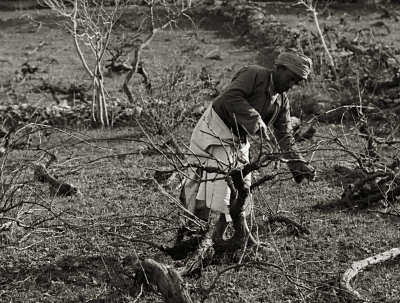
The work in the vineyards consists in
hoeing and breaking up the ground several
times after the rains, and in pruning the
vines. Bits of rock are carefully taken out of
the ground, but beyond this the Fellah bestows
but little pains on his vineyard.
(Source: Klein 1883: 46.)
No tree requires such constant and severe
pruning as the Vine. We know that in the
vineyards of France the whole wood is cut back
to the stump every year, and in like manner in
the East only three or four leaders are left
from the top of the main stem, which is about
five or six feet high, so soon as the vintage
is over. (Source: Tristram 1868:
408.)
See Grain, Olive Trees and Pressing, or Fishing and Fishermen
At BiblePlaces, see Grapevines and Vineyards or Grape Harvest
Sources:
Baldensperger, Philip J.
1901 Women in the East. Palestine Exploration Fund Quarterly Statement. 66-90, 167-84, 252-73.
1908 The Immovable East. Palestine Exploration Fund Quarterly Statement. 290-98.
Klein, F. A.
1883 Life, Habits and Customs of the Fellahin of Palestine. Palestine Exploration Fund Quarterly Statement. 41-48.
Tristram, Henry Baker.
1868 The Natural History of the Bible: being a review of the physical geography, geology, and meteorology of the Holy Land, with a description of every animal and plant mentioned in Holy Scripture. 2nd ed. London: Society for Promoting Christian Knowledge.