
Women and Their Work
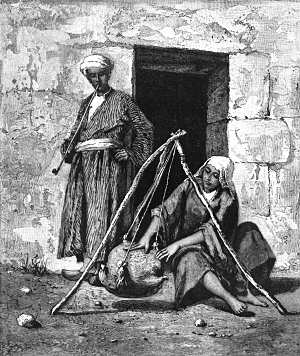
Source: Picturesque Palestine, vol. 3, p. 48
A Peasant Woman Churning
The deep degradation of the peasant women of the Orient is graphically pictured by Layard. ‘These poor creatures, like all Arab women, were exposed to constant hardships. They were obliged to look after the children, make bread, fetch water, and cut wood, which they brought home from afar on their heads . . . They wove their wool and goat’s hair into cloths, carpets, and tent-canvas; were left to strike and raise the tents; to load and unload the beasts of burden, when they changed camping-ground . . . They had to drive the sheep and cows to the pasture, and milk them at night . . . They carried their children on their backs during the march, and even when employed in domestic occupations.’ They brought water from the river, in large sheep or goat-skins filled and hung on the back by cords strapped over the shoulders, and, in addition, upon it was frequently seated the child who could not be left and was unable to follow its mother on foot. ‘. . . The men sat indolently by, smoking their pipes or listening to a trifling story from some strange Arab of the desert.’ (Source: Rice (1929), pp. 65-66.)
Arab Women Working a Hand Mill
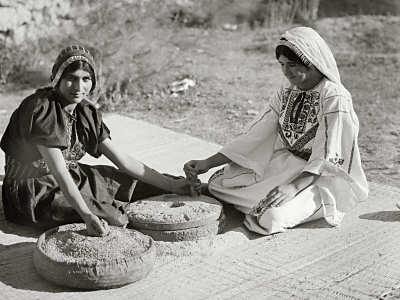
There are no water-mills in the south, though they are common enough in the watered mountainous region under Lebanon, and may be found in some places near the Jordan . . . . In all the south, hand-mills are the sole means of providing flour. Severe as is the labour, we fear that men never condescend to it. In the houses of the richer class several servant-maids or slave-girls are kept continually at the tedious task. “From Pharaoh to the maidservant that is behind the mill,” shows the estimation in which grinding was held. As we pass through the streets at the evening hour we hear the low monotonous hum of the hand-mill . . . . There is a hole in the centre of the upper millstone through which the grain is passed, a handful at a time, by one of the two women who sit facing each other. “Two women shall be grinding at the mill.” Nearer the edge is another hole, in which an upright handle is fixed; both the women hold this together, and work it as two men would a crosscut saw. The flour falls out on to a cloth on which the nether millstone is placed. (Source: Picturesque Palestine, vol. 1, pp. 135-136.)
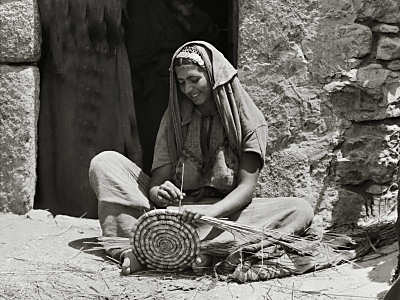
Woman Weaving Reed Baskets
During the harvest the women pick out the best straws they can find, and bind them into bundles; in their leisure hours they make baskets, trays, and the like for the household furniture. Some of the straws are coloured green or red, and symmetrically women into the work, designed generally in curves or broken lines. Some are very dexterous in making these trays, and produce a certain quantity for sale, for they always find a ready market. (Source: Baldensperger (1901), p. 73.)
Women in the Hill Country of Judaea
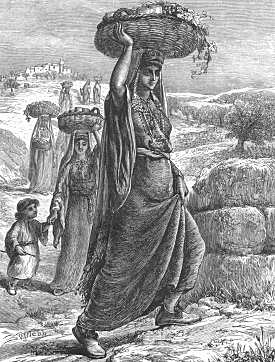
Source: Those Holy Fields, p. 24
The women are very dexterous in carrying loads on their heads and keeping them in equilibrium. Everything, except the babies and the skin water-bottle, is carried on their heads. (Source: Baldensperger (1901), p. 67.)
Although an exception, I have known a woman carry a big basket of cabbages to Bethlehem, some three miles distant from her village; on the way she was delivered of a boy, without assistance, rolled him into her huge sleeve, and continued her way to the market; having sold her cabbages, she late in the afternoon walked home with the boy in her sleeve, without being troubled in the least. (Source: Baldensperger (1990) p. 180.)
See Weddings, Houses, Marketplace, Women and Clothing, Woman at the Well, or Grain
At BiblePlaces, see Grain Harvest or John 4
Sources:
Baldensperger, Philip J.
1900 Women in the East. Palestine Exploration Fund Quarterly Statement. 171-190.
1901 Women in the East. Palestine Exploration Fund Quarterly Statement. 66-90, 167-84, 252-73.
Rice, Edwin Wilbur.
1929 Orientalisms in Bible Lands. 3rd ed. Philadelphia: The American Sunday-School Union.